
Can teeth grinding cause tooth sensitivity?
Grinding and clenching can wear enamel down until cold drinks sting. Why grinding makes teeth sensitive, what else it could be, what helps and when to see a dentist.

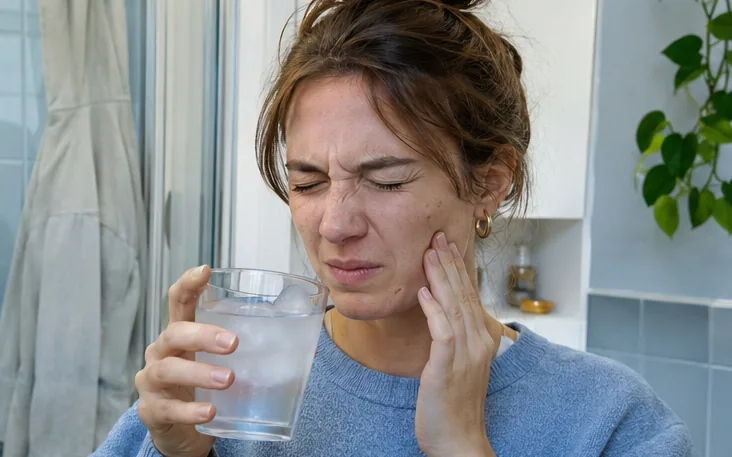
You take a sip of iced water or bite into ice cream, and one tooth answers with a sharp, electric twinge. If you already know you grind at night or catch yourself clenching at your desk, it makes sense to wonder whether the two are connected. As a physiotherapist who works with jaw problems every day, I get asked this a lot.
You are in good company, and the link between grinding and sensitive teeth is well described. In this article you will learn how grinding makes teeth sensitive, what else could be behind that twinge, what you can do about it at home and which signs mean you should book a dentist rather than wait.
Key takeaways
Yes, grinding and clenching can make your teeth sensitive. Grinding and clenching can wear enamel down and expose the dentin underneath, which reacts to hot, cold, sweet and sour things (Cleveland Clinic, 2025). The NHS lists worn-down or broken teeth with increased sensitivity among the symptoms of grinding (NHS, 2026).
- Grinding is one common cause, but cavities, gum recession and cracks can feel exactly the same.
- Desensitising toothpaste relieves symptoms in trials, while your dentist works out the cause.
- Sharp pain that lingers or pain when you bite on one tooth needs a dental check soon.
Why do sensitive teeth hurt in the first place?
Under your hard outer enamel sits a softer layer called dentin. Dentin is full of tiny tubes that lead to the centre of the tooth where the nerve lives, and once it is exposed, temperature changes and sugar can travel down those tubes and trigger pain (Cleveland Clinic, 2025). Dentists call this dentin hypersensitivity.
Dentin gets exposed in two main ways. The enamel on the biting surface can wear away, or the gums can pull back and uncover the root surface near the gumline (Cleveland Clinic, 2025). Cleveland Clinic names grinding as a cause of the first route, enamel wear (Cleveland Clinic, 2025).
Can teeth grinding cause sensitivity to cold?
Yes, and cold is usually the first thing people notice. Cleveland Clinic names clenching and grinding as a cause of sensitive teeth because they wear down enamel and can expose dentin (Cleveland Clinic, 2025). The NHS goes further and lists worn-down or broken teeth, increased sensitivity and lost fillings as typical symptoms of grinding, and advises seeing a dentist if you grind and have tooth damage or sensitive teeth (NHS, 2026).
Grinding can happen while you are asleep or awake (NHS, 2026), so you may not know you do it. The NHS lists a painful jaw, worn-down teeth, headaches and earache among the signs (NHS, 2026). Our guide on how to tell if you grind your teeth at night walks you through the checks, and if your dentist has already mentioned flat teeth, read about worn-down teeth.
What are those notches at the gumline?
Many people who clench have small notches or scooped-out areas where the tooth meets the gum. Dentists call them non-carious cervical lesions, meaning tooth loss near the gumline that has nothing to do with decay. They often expose dentin and are a common reason for sensitivity at the neck of the tooth.
Whether clenching causes them is still debated. A systematic review of 69 studies found that most of them reported a link between biting stress and these lesions, but no clinical study showed that stress alone caused one (Duangthip et al., 2017). A later review describes the cause as multifactorial, with hard horizontal brushing and acidic food and drink playing a big part, and notes that some studies support the idea of stress from biting while others find no link (Goodacre et al., 2023). In practice that means brushing technique and diet deserve as much attention as your jaw.
Could it be something other than grinding?
Sensitivity is a symptom with several possible sources, and some of them need treatment. Cleveland Clinic lists acidic foods, brushing too hard, gum disease, gum recession, plaque, recent dental work, whitening products and cracked teeth as other causes, and warns that sensitivity can be a sign of a cavity or a crack (Cleveland Clinic, 2025).
Cracks deserve a special mention here. A 2026 review in the Journal of Endodontics names bruxism as a key risk factor for cracked teeth, alongside a misaligned bite and weakened enamel (Pryles et al., 2026). If tooth pain comes with jaw pain, clicking, headache or ear pain, the jaw muscles can be part of the picture too. The NIDCR lists pain in the chewing muscles or jaw joint, and pain that spreads to the face or neck, among the symptoms of TMD (NIDCR, 2026), and the NHS notes that teeth grinding can cause TMD (NHS TMD, 2023). The muscle side is explained in can TMJ cause tooth pain.
What helps with sensitive teeth from grinding?
The goal is to calm the exposed dentin and reduce the load that caused it. Your dentist decides on the dental side, and you can handle much of the everyday part yourself.
In the moment
- Switch to a desensitising toothpaste. A meta-analysis of 53 randomised trials with 4,796 people found that toothpastes with potassium, stannous fluoride, arginine, calcium sodium phosphosilicate or nano-hydroxyapatite relieved sensitivity better than regular toothpaste (Hu et al., 2018).
- Cleveland Clinic suggests dabbing a little desensitising toothpaste on the sore spot before bed, and using a soft-bristled brush with gentle pressure (Cleveland Clinic, 2025).
- Cut back on acidic food and drink such as citrus and pickles, which wear enamel further (Cleveland Clinic, 2025).
Over the long run
- Ask your dentist about a mouth guard. The NHS explains that a guard or splint worn at night protects your teeth from grinding damage (NHS, 2026), and Cleveland Clinic lists wearing one if you grind as a way to prevent sensitivity (Cleveland Clinic, 2025).
- Your dentist can also seal or bond exposed areas or apply fluoride varnish (Cleveland Clinic, 2025).
- Work on the clenching itself. The NHS advises keeping your teeth apart except when you eat and finding ways to relax (NHS TMD, 2023), and the NIDCR advises reducing habits such as jaw clenching, gum chewing or nail biting (NIDCR, 2026). Our teeth grinding guide covers the bigger picture.
A guard protects the teeth while you sleep. Daytime clenching is something you can retrain, and that is where I spend most of my time with patients.
Try it: the teeth-apart check
This is the first habit I teach people whose teeth are taking a beating. It takes about a minute.
- Sit or stand comfortably and notice where your teeth are right now. If your back teeth are touching, you have found daytime clenching.
- Let your lips stay closed but allow your teeth to drift a few millimetres apart.
- Rest the tip of your tongue lightly on the roof of your mouth, just behind your upper front teeth.
- Breathe slowly through your nose for a few breaths and let your cheeks and jaw soften with each breath out.
- Repeat the check whenever you open your laptop, pick up your phone or sit in traffic, so it starts to link with things you do every day.
You should feel the jaw muscles go softer and the pressure on your teeth ease. It should never hurt. If you notice sharp tooth pain, locking or new clicking while doing this, stop and get it looked at. There is no studied number of repetitions for this check, so use your daily cues rather than a count.
How JawBuddy helps
JawBuddy is a digital companion for guided jaw exercises and self-management, so it covers the part of the plan that happens between dental visits. It reminds you to check in on your jaw during the day, guides you through relaxation and jaw exercises, and keeps a pain diary you can export as a report for your dentist.
It works on iPhone and Android. JawBuddy does not replace your dentist or an individual diagnosis, so sensitivity that lingers still needs a professional look.
When to seek help
Go to A&E or call 999 right away if:
- toothache comes with swelling around your eye or in your neck (NHS toothache, 2024)
- swelling in your mouth or neck makes it hard to breathe, swallow or speak (NHS toothache, 2024)
See a dentist soon if:
- toothache lasts more than 2 days or does not settle with painkillers (NHS toothache, 2024)
- you have a high temperature, pain when you bite, red gums or a bad taste in your mouth (NHS toothache, 2024)
- one tooth hurts sharply, because sensitivity can be a sign of a cavity or crack (Cleveland Clinic, 2025)
- you grind your teeth and have tooth damage or sensitive teeth (NHS, 2026)
You do not have to just live with the twinge
Sensitive teeth from grinding are common and very manageable once you know the cause. Book a dental check to rule out cavities and cracks, switch to a desensitising toothpaste, and start the teeth-apart check today. If your jaw aches as well, our jaw pain guide is a good next read.
Frequently asked questions
Can teeth grinding cause sensitivity to cold?+
Does a mouth guard help with sensitive teeth from grinding?+
What toothpaste helps sensitive teeth from grinding?+
When is tooth sensitivity a reason to see a dentist?+
References
- Duangthip D, Man A, Poon PH, Lo ECM, Chu CH. Occlusal stress is involved in the formation of non-carious cervical lesions. A systematic review of abfraction. American Journal of Dentistry 30(4), 212-220, 2017. ↗
- Hu ML, Zheng G, Zhang YD, Yan X, Li XC, Lin H. Effect of desensitizing toothpastes on dentine hypersensitivity: A systematic review and meta-analysis. Journal of Dentistry 75, 12-21, 2018. ↗
- Goodacre CJ, Eugene Roberts W, Munoz CA. Noncarious cervical lesions: Morphology and progression, prevalence, etiology, pathophysiology, and clinical guidelines for restoration. Journal of Prosthodontics 32(2), e1-e18, 2023. ↗
- NHS. Temporomandibular disorder (TMD). National Health Service, UK, page last reviewed 20 June 2023. ↗
- NHS. Toothache. National Health Service, UK, page last reviewed 01 July 2024. ↗
- Cleveland Clinic. Sensitive Teeth: Causes, Treatment & Prevention. Cleveland Clinic Health Library, last updated 07/03/2025. ↗
- NHS. Teeth grinding (bruxism). National Health Service, UK, page last reviewed 08 April 2026. ↗
- Pryles RL, Blicher B, Gluskin AH. Preventive Endodontics: Mitigating Crack Development and Tooth Loss. Journal of Endodontics 52(3), 353-358, 2026. ↗
- National Institute of Dental and Craniofacial Research (NIDCR). TMD (Temporomandibular Disorders). NIH, accessed 25 November 2026. ↗
Continue reading
Is there an app that measures how wide your jaw opens?
A physio explains how wide a mouth normally opens, how dentists measure it, what camera-based jaw tracking research shows and how to follow your jaw opening between appointments.
Why does my masseter hurt?
Masseter pain usually comes from an overworked chewing muscle. Where it spreads, how to tell it apart from joint, tooth and gland problems, and what helps.
What is the 3 finger test for TMJ?
The 3 finger test checks whether your mouth opens wide enough to fit three stacked fingers between your front teeth. How to do it properly, what normal looks like in millimetres, where the test falls short and when to get your jaw checked.
Why does my tongue have teeth marks on the sides?
A scalloped tongue has wavy teeth marks along its edges. A physio explains what the studies say about clenching, sleep apnea and thyroid problems, and when to get it checked.