
What is the 3 finger test for TMJ?
The 3 finger test checks whether your mouth opens wide enough to fit three stacked fingers between your front teeth. How to do it properly, what normal looks like in millimetres, where the test falls short and when to get your jaw checked.

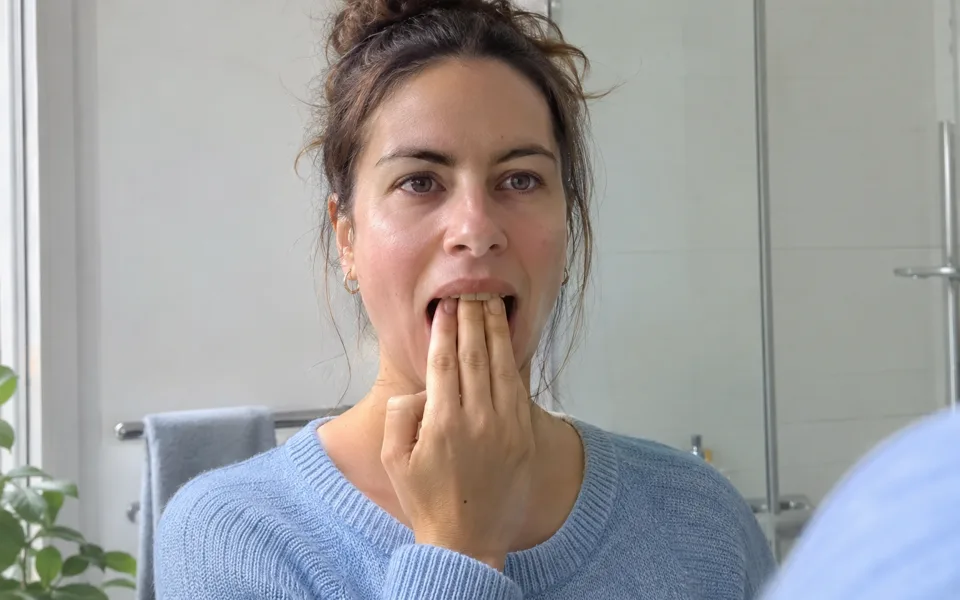
Maybe someone online told you to stick three fingers in your mouth to check your jaw, or your dentist did it at your last visit and you wondered what it actually shows. It's a quick, slightly odd-looking test, and it's genuinely useful once you know how to read it.
In this article I'll show you how to do the 3 finger test properly, what counts as normal in millimetres, what a smaller result can and can't tell you, and which signs mean you should get your jaw looked at.
Key takeaways
The 3 finger test checks whether your index, middle and ring fingers, stacked vertically, fit between your upper and lower front teeth. In 140 healthy adults, everyone could fit three fingers, and the three-finger width (about 47 mm) matched their measured maximum opening of about 49 mm closely (Zawawi et al., 2003).
- Three fingers is a practical sign of normal opening; fewer means your opening deserves a closer look.
- The test screens opening only and can't tell you whether you have a TMJ disorder.
- Pain, locking or opening that keeps shrinking matter more than the exact finger count.
How do you do the 3 finger test?
The method comes from a study at Boston University. Participants placed three fingers of one hand, aligned vertically, between their upper and lower central incisors up to the first crease below the fingertip, the one at the last finger joint (Zawawi et al., 2003). That detail matters, because pushing your fingers in up to the middle knuckle gives a much bigger number.
You use your own fingers on purpose. In a study of 500 adults, the width of each person's three fingers correlated with their own measured maximum opening, which is why the test works as a rough personal ruler without any equipment (Agrawal et al., 2015).
What is a normal result?
Three fingers is normal. In the Zawawi study, every one of the 140 participants could fit three fingers of both the right and left hand, while only 12 managed four (Zawawi et al., 2003). A larger study of 500 healthy adults in India found the same pattern: people in every age group could fit three fingers, and average maximum opening was about 50 mm for both men and women (Agrawal et al., 2015).
In millimetres, the Cleveland Clinic gives 40 to 60 mm as the usual range for opening and says people with trismus, the medical term for restricted opening, may not get past 20 to 35 mm (Cleveland Clinic, 2025). Averages also shift with age and population. In a national survey of 1,513 Irish adults aged 16 to 99, men opened 43 mm and women 41 mm on average, and opening got smaller with age (Gallagher et al., 2004).
One number you'll often see online is 40 mm. The international diagnostic criteria for TMD (DC/TMD) use an assisted opening under 40 mm, including the overlap of the front teeth, but only to label a specific joint problem, a displaced disc that doesn't slide back, as "with limited opening" (Schiffman et al., 2014). It isn't a general cut-off for TMD, so a 38 mm mouth isn't automatically a disordered one.
Try it: the 3 finger test at home
This is how I walk people through it in physiotherapy. Skip it if your jaw is stuck open, and go straight to the section on when to seek help.
- Wash your hands, sit upright and let your head rest straight, without tipping it back.
- Open slowly as wide as is comfortable. You should feel a stretch in your cheeks or in front of your ears, but no sharp pain.
- Stack your index, middle and ring fingers of one hand vertically, nails facing you, and slide them between your upper and lower front teeth up to the first crease below the fingertips.
- Note how many fingers fit without forcing, and whether your jaw swerves to one side as you open.
- If anything hurts, note where: cheek, temple, in front of the ear or a tooth.
- Close gently and repeat once with the other hand.
Stop if the test makes your jaw catch or lock, or if the pain clearly rises. Don't push to "make" three fingers fit, because forcing the jaw open can irritate sore muscles. In practice I suggest repeating it at the same time of day for a week, since a trend tells you more than a single try.
What can a smaller result mean?
Fitting only one or two fingers means your opening is below the usual range, and it's worth finding out why. The NHS lists difficulty opening your mouth fully and your jaw locking when you open it among the symptoms of TMD, alongside jaw pain, ear pain, headaches and clicking or popping (NHS TMD, 2023). The NIDCR also describes limited movement or locking of the jaw as a TMD symptom (NIDCR, 2026).
TMD isn't the only cause, though. The Cleveland Clinic names head and neck cancer treatment and wisdom tooth removal as main causes of restricted opening, alongside TMD, and lists infections and jaw injuries among the other causes (Cleveland Clinic, 2025). A dental abscess, for example, can make it hard to open your mouth and is often accompanied by swelling or a fever (NHS dental abscess, 2026). For the full list of causes and how they're treated, read why can't I open my mouth all the way?
Where does the finger test fall short?
The test is a screen, and it has real limits.
- Fingers vary. People with broad or slim fingers relative to their jaw can get a misleading result, and swollen joints change it too.
- It's coarse. Three fingers measured about 47 mm in the Zawawi study, so each finger works out at a rough 15 mm (Zawawi et al., 2003). A 5 mm change over a few weeks disappears inside the same finger count.
- It says nothing about pain or sound. A jaw that clicks, aches or swerves can still fit three fingers.
- It doesn't diagnose. Under the DC/TMD, a clinician measures pain-free opening, maximum opening on your own and assisted opening in millimetres, and checks whether pressing on the muscles and joints brings on your familiar pain (Schiffman et al., 2014).
If you want to know whether your symptoms point to a joint problem or simply tight muscles, how do I know if I have TMJ or just jaw tension? goes through the differences.
How JawBuddy helps
If you'd like a finer measure than fingers, the AR jaw check in JawBuddy 3.0 uses your phone camera to measure your mouth opening in millimetres, plus symmetry and deviation, in a few seconds. It isn't a diagnosis or a medical measurement, but it lets you track your opening over time and share the results with your dentist or physio. Our article on apps that measure jaw opening explains how this kind of tracking works.
The app also gives you one guided exercise each day, shown on video by a physiotherapist, from more than 100 exercises designed by dentists and physiotherapists, on iPhone and Android.
When to seek help
Right away: call 999 (UK), 911 (US) or 112 (EU) or go to the emergency department if:
- you have toothache or a suspected tooth infection and find it hard to open your mouth, have a lot of swelling in your mouth, a swollen or painful eye, or trouble breathing, speaking or swallowing (NHS dental abscess, 2026),
- your jaw is stuck open and won't close, or you think it is dislocated or broken, because that needs medical attention right away (MedlinePlus, 2025),
- you have chest pain that feels tight or squeezing, or chest pain spreading to your arms, neck or jaw, which can be a heart attack (NHS heart attack, 2026).
Soon: ask for an urgent GP or dentist appointment, or call 111 in the UK, if:
- you have difficulty opening your mouth fully or your jaw keeps locking (NHS TMD, 2023),
- you're unable to eat or drink, or have frequent, severe headaches (NHS TMD, 2023),
- you have pain around your jaw, ear or the side of your head, or clicking, popping or grinding noises when you move your jaw (NHS TMD, 2023),
- your finger count keeps dropping over days or weeks without a clear reason.
For TMD, the NIDCR recommends starting with conservative, reversible care such as heat or cold, gentle jaw exercises and avoiding treatments that permanently change your bite (NIDCR, 2026). Our TMJ exercises page is a good place to begin once serious causes are ruled out.
Three fingers is a starting point
The 3 finger test gives you a quick, honest snapshot of how far your jaw opens, and that's useful information to bring to any appointment. Try it once today, write down the result and how it felt, and compare it in a week. For the wider picture on what might be behind your symptoms, start with our jaw pain overview.
Frequently asked questions
What is the 3 finger test for TMJ?+
How many millimetres is three fingers?+
What does it mean if only two fingers fit?+
Can the 3 finger test diagnose TMJ disorder?+
References
- Zawawi KH, Al-Badawi EA, Lobo SL, Melis M, Mehta NR. An index for the measurement of normal maximum mouth opening. Journal of the Canadian Dental Association 69(11), 737-741, 2003. ↗
- Gallagher C, Gallagher V, Whelton H, Cronin M. The normal range of mouth opening in an Irish population. Journal of Oral Rehabilitation 31(2), 110-116, 2004. ↗
- Schiffman E, Ohrbach R, Truelove E, et al. Diagnostic Criteria for Temporomandibular Disorders (DC/TMD) for Clinical and Research Applications. Journal of Oral & Facial Pain and Headache 28(1), 6-27, 2014. ↗
- Agrawal J, Shenai PK, Chatra L, Kumar PY. Evaluation of normal range of mouth opening using three finger index: South India perspective study. Indian Journal of Dental Research 26(4), 361-365, 2015. ↗
- NHS. Temporomandibular disorder (TMD). National Health Service, UK. Page last reviewed 20 June 2023. ↗
- Cleveland Clinic. Trismus. Health Library, medically reviewed 22 July 2025. ↗
- MedlinePlus Medical Encyclopedia. Broken or dislocated jaw. US National Library of Medicine, review date 3 April 2025. ↗
- National Institute of Dental and Craniofacial Research (NIDCR). TMD (Temporomandibular Disorders). National Institutes of Health. ↗
- NHS. Dental abscess. National Health Service, UK. Page last reviewed 18 March 2026. ↗
- NHS. Heart attack. National Health Service, UK. Page last reviewed 31 March 2026. ↗
Continue reading
Is there an app that measures how wide your jaw opens?
A physio explains how wide a mouth normally opens, how dentists measure it, what camera-based jaw tracking research shows and how to follow your jaw opening between appointments.
Why does my masseter hurt?
Masseter pain usually comes from an overworked chewing muscle. Where it spreads, how to tell it apart from joint, tooth and gland problems, and what helps.
Can teeth grinding cause tooth sensitivity?
Grinding and clenching can wear enamel down until cold drinks sting. Why grinding makes teeth sensitive, what else it could be, what helps and when to see a dentist.
Why does my tongue have teeth marks on the sides?
A scalloped tongue has wavy teeth marks along its edges. A physio explains what the studies say about clenching, sleep apnea and thyroid problems, and when to get it checked.