
Why can't I open my mouth all the way?
Limited mouth opening explained by a physio: how wide a mouth normally opens, the common and rare causes, how clinicians examine it, a three-finger check you can do at home and what helps.

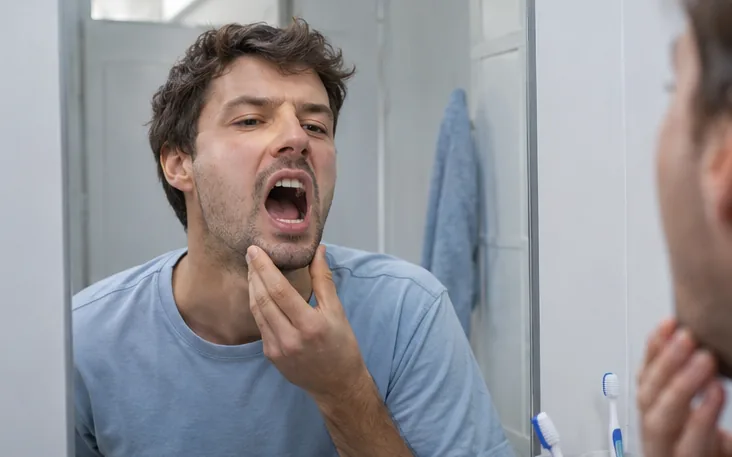
Maybe your dentist kept asking you to open wider and your jaw simply wouldn't go. A mouth that opens less than it used to is unsettling. Clinicians call it trismus.
In this guide I'll explain the normal range of opening and the causes that can hold it back, including how a dentist or doctor tells them apart. You'll also learn a quick finger check you can do at home today and which signs mean you shouldn't wait.
Key takeaways
Most mouths open about 40 to 60 millimetres, roughly two to three fingers stacked on top of each other (Cleveland Clinic, 2025). When yours opens less, the main causes are jaw joint and muscle problems (TMD), wisdom tooth removal and treatment for head and neck cancer, and others include infections, injuries, inflammatory joint disease and tumours (Cleveland Clinic, 2025).
- Three of your own fingers between your front teeth is a practical sign of normal opening.
- With many causes, restricted opening improves within about two weeks (Cleveland Clinic, 2025).
- Opening that keeps shrinking, or comes with swelling, fever or trouble swallowing, needs a professional.
How wide should your mouth open?
Clinicians measure opening as the distance between the edges of your upper and lower front teeth. The Cleveland Clinic gives 40 to 60 millimetres as the usual range, and says people with trismus may not open wider than 20 to 35 millimetres (Cleveland Clinic, 2025).
Averages vary with age and sex. In a national survey of 1,513 Irish adults aged 16 to 99, men opened 43 millimetres and women 41 millimetres on average, opening got smaller with age, and body height made no difference (Gallagher et al., 2004). What matters most is whether your opening has changed and whether it gets in your way.
Some fields use fixed cut-offs. The international diagnostic criteria for TMD, called DC/TMD, use an assisted opening below 40 millimetres, including the overlap of the front teeth, to mark a displaced disc as one "with limited opening" (Schiffman et al., 2014). After treatment for head and neck cancer, a Dutch study found 35 millimetres or less to be the most useful line for trismus (Dijkstra et al., 2006).
What can stop your mouth from opening fully?
Some causes sit in the jaw muscles and joint themselves, and others in the teeth, surrounding tissue or medical treatment.
Jaw muscles and the jaw joint
The Cleveland Clinic names TMD as one of the main causes of trismus, alongside wisdom tooth removal and cancer treatment (Cleveland Clinic, 2025). If your jaw feels tense rather than blocked, why does my jaw feel tight? goes deeper into that side of things.
A disc in the jaw joint that slips forward and stays there can also block opening. Clinicians call this disc displacement without reduction, or a closed lock (Schiffman et al., 2014). What to do in that moment is covered in what should you do if your jaw locks?
Dental injections and procedures
The numbing injection for lower teeth can irritate a chewing muscle on the inside of the jaw. A US case report describes a patient who developed a clearly restricted opening the day after three of these injections and a routine filling, with muscle pain when she tried to open further, without swelling, swollen glands or fever (Wright, 2011). Wisdom tooth surgery, especially on the lower teeth, is another known trigger, partly because the jaw is held wide open during the operation (Cleveland Clinic, 2025). If dental work started your symptoms, our guide to jaw pain after dental work walks through that situation.
Infection and inflammation
A dental abscess can make it hard to open your mouth and chew, often with swelling, a bad taste or a high temperature (NHS dental abscess, 2026). The Cleveland Clinic also lists infections of the teeth, neck, tonsils or salivary glands, mumps and tetanus, and injuries to the jaw (Cleveland Clinic, 2025).
Inflammatory arthritis can reach the jaw joint too. A German clinical guideline reports joint involvement in 40 to 90 per cent of people with rheumatoid arthritis or juvenile idiopathic arthritis, often without symptoms, and restricted jaw movement with pain in about one in five children and teens with juvenile arthritis (Schmidt et al., 2022).
Radiotherapy and tumours
Head and neck cancer treatment is one of the main causes of trismus (Cleveland Clinic, 2025). A systematic review found trismus in about 25 per cent of people after conventional radiotherapy and around 5 per cent in the few studies of more targeted intensity-modulated radiotherapy (Bensadoun et al., 2010). The Cleveland Clinic notes that head and neck tumours themselves can also cause trismus (Cleveland Clinic, 2025). This is one reason a slowly worsening opening with no obvious cause should be checked.
How do doctors and dentists examine limited opening?
The Cleveland Clinic describes the basics as questions about your symptoms, an examination of the jaw and neck, and often the three-finger test, with CT or MRI in some cases (Cleveland Clinic, 2025).
A TMD examination under the DC/TMD measures several things. The clinician checks how far you open without pain, how far you open on your own and how far with gentle help. They also press on your chewing muscles and joints and ask whether that brings on your "familiar pain", meaning the same pain you know from daily life (Schiffman et al., 2014). Infection or rheumatoid disease can produce familiar pain too, so other causes have to be ruled out. MRI is needed for a definitive diagnosis of a displaced disc, although a closed lock with limited opening can be diagnosed quite reliably from the clinical exam alone (Schiffman et al., 2014).
Try it: the three-finger check
This is the first thing I do in physiotherapy when someone tells me their mouth won't open properly. Skip it if your jaw is stuck open, and go straight to the doctor section below.
- Wash your hands, sit upright and open slowly as far as is comfortable, without pushing through sharp pain.
- Stack your index, middle and ring fingers vertically and slide them between your upper and lower front teeth, up to the first crease of the fingers.
- Note whether two, three or more fingers fit, and whether your jaw drifts to one side as it opens.
- Point to where it hurts, if it hurts, and write it down: cheek, temple, in front of the ear or a tooth.
- Repeat once a day at the same time for a week and compare.
In a study of 140 dental students, everyone could fit three fingers, and the three-finger width matched the measured opening closely (Zawawi et al., 2003). They were healthy young adults, so one finger short is a reason to watch the trend rather than a diagnosis. Stop if the check makes your jaw lock or the pain clearly rises.
What helps when your mouth won't open fully?
That depends on the cause. The Cleveland Clinic says clinicians start by treating the cause, for example with antibiotics or removing an infected tooth, and may add anti-inflammatory painkillers, muscle relaxants or physical therapy with stretching exercises and devices that gently open the jaw (Cleveland Clinic, 2025).
In the moment
For TMD-type restriction, the NHS suggests soft foods, paracetamol or ibuprofen, an ice pack or heat pack wrapped in a tea towel, gently massaging the sore muscles, and not chewing gum or yawning too wide (NHS TMD, 2023). The Cleveland Clinic adds moist heat on the jaw and neck for 15 to 20 minutes (Cleveland Clinic, 2025).
Over the coming weeks
For TMD, the NIDCR recommends conservative treatment, such as heat or cold together with gentle stretching and strengthening exercises, and avoiding treatments that permanently change your teeth, bite or jaw joints (NIDCR, 2026). A systematic review of trials in painful TMD found that exercise, particularly coordination exercises that train smooth, controlled opening, can reduce pain and improve jaw movement, although the review found only five small trials with 145 participants in total (Shimada et al., 2023). Our TMJ exercises page shows where to begin.
After cancer treatment, the evidence is more mixed. A review of 20 studies found that, in the treatment studies, opening changed by anything from a slight loss of 1.9 millimetres to a gain of 24 millimetres. Most studies of exercise during radiotherapy could not prevent opening from shrinking, and no stretching method was clearly better than another (Kamstra et al., 2017). Radiation-related trismus often gets worse for several months before it improves, so involve your care team early (Cleveland Clinic, 2025). For rheumatoid arthritis in the jaw joint, the German guideline reports that treating the underlying disease with conservative care fails in fewer than 10 per cent of patients (Schmidt et al., 2022).
How JawBuddy helps
JawBuddy is a digital companion for guided jaw exercises and self-management. Once a professional has checked the cause of your limited opening, it can help you turn gentle opening and coordination exercises into a daily routine.
It does not replace emergency care or an individual diagnosis from a qualified healthcare professional, so swelling, fever or a jaw that is getting steadily worse always goes to a dentist or doctor first.
When should you see a doctor?
Right away: call 999 (UK), 911 (US) or 112 (EU) or go to the emergency department if:
- you find it hard to open your mouth and have a lot of swelling in your mouth, a swollen or painful eye, or trouble breathing, speaking or swallowing (NHS dental abscess, 2026),
- you have a stiff jaw, trouble swallowing or painful muscle spasms after a wound such as a bite, burn or scratch (NHS tetanus, 2026),
- in my experience, a jaw that is stuck open and won't close also needs emergency care.
Soon: get an urgent appointment with a dentist or GP, or call 111 in the UK, if:
- you have difficulty opening your mouth fully, your jaw keeps locking, or you can't eat or drink (NHS TMD, 2023),
- you have toothache, a bad taste or a high temperature along with the restricted opening, which can point to an abscess (NHS dental abscess, 2026),
- you have frequent severe headaches or vision problems such as double vision (NHS TMD, 2023),
- your opening is getting smaller week by week without a clear reason, or you've had radiotherapy to the head or neck and notice it tightening (Cleveland Clinic, 2025).
A GP can refer you to a dentist or to a physiotherapist for jaw exercises and massage (NHS TMD, 2023). Not sure who to see first? Read dentist or physiotherapist for TMJ?
Your jaw can find its range again
A smaller opening feels alarming, but many causes are muscular or temporary and respond to time and gentle, consistent work. Do the three-finger check once today and write down the result, so you have something concrete to compare and to show your dentist. For the wider picture, start with our jaw pain overview or the TMJ disorder guide.
Frequently asked questions
How wide should your mouth be able to open?+
What is the three-finger test for mouth opening?+
What is the most common reason you can't open your mouth all the way?+
Is trismus the same as lockjaw from tetanus?+
When is limited mouth opening an emergency?+
References
- Zawawi KH, Al-Badawi EA, Lobo SL, Melis M, Mehta NR. An index for the measurement of normal maximum mouth opening. Journal of the Canadian Dental Association 69(11), 737-741, 2003. ↗
- Gallagher C, Gallagher V, Whelton H, Cronin M. The normal range of mouth opening in an Irish population. Journal of Oral Rehabilitation 31(2), 110-116, 2004. ↗
- Dijkstra PU, Huisman PM, Roodenburg JL. Criteria for trismus in head and neck oncology. International Journal of Oral and Maxillofacial Surgery 35(4), 337-342, 2006. ↗
- Bensadoun RJ, Riesenbeck D, Lockhart PB, et al. A systematic review of trismus induced by cancer therapies in head and neck cancer patients. Supportive Care in Cancer 18(8), 1033-1038, 2010. ↗
- Wright EF. Medial pterygoid trismus (myospasm) following inferior alveolar nerve block: case report and literature review. General Dentistry 59(1), 64-67, 2011. ↗
- Schiffman E, Ohrbach R, Truelove E, et al. Diagnostic Criteria for Temporomandibular Disorders (DC/TMD) for Clinical and Research Applications: recommendations of the International RDC/TMD Consortium Network and Orofacial Pain Special Interest Group. Journal of Oral & Facial Pain and Headache 28(1), 6-27, 2014. ↗
- Kamstra JI, van Leeuwen M, Roodenburg JLN, Dijkstra PU. Exercise therapy for trismus secondary to head and neck cancer: a systematic review. Head & Neck 39(1), 160-169, 2017. ↗
- Schmidt C, Ertel T, Arbogast M, Hügle B, von Kalle T, Neff A. The diagnosis and treatment of rheumatoid and juvenile idiopathic arthritis of the temporomandibular joint. Deutsches Ärzteblatt International 119(4), 47-54, 2022. ↗
- Shimada A, Ogawa T, Sammour SR, et al. Effectiveness of exercise therapy on pain relief and jaw mobility in patients with pain-related temporomandibular disorders: a systematic review. Frontiers in Oral Health 4, 1170966, 2023. ↗
- NHS. Temporomandibular disorder (TMD). National Health Service, UK. Page last reviewed 20 June 2023. ↗
- Cleveland Clinic. Trismus. Health Library, medically reviewed, last updated 22 July 2025. ↗
- National Institute of Dental and Craniofacial Research (NIDCR). TMD (Temporomandibular Disorders). National Institutes of Health, accessed 14 November 2026. ↗
- NHS. Dental abscess. National Health Service, UK. Page last reviewed 18 March 2026. ↗
- NHS. Tetanus. National Health Service, UK, accessed 14 November 2026. ↗
Continue reading
Why does my tongue have teeth marks on the sides?
A scalloped tongue has wavy teeth marks along its edges. A physio explains what the studies say about clenching, sleep apnea and thyroid problems, and when to get it checked.
Why are my teeth worn down?
Worn down teeth come from grinding, clenching, brushing or acid, usually several at once. A physio explains what your dentist checks and when worn teeth need treatment.
Why does my jaw hurt after dental work?
Jaw pain after a filling, crown, root canal or extraction is common. A physio explains what causes it, how long it normally lasts, what helps and which signs mean you should call your dentist.
Why does my jaw hurt when I chew?
Jaw pain when chewing usually comes from the chewing muscles, the jaw joint or a tooth. A physio explains how to tell them apart, how to eat more gently and which signs need a doctor.