
Why does my jaw hurt after dental work?
Jaw pain after a filling, crown, root canal or extraction is common. A physio explains what causes it, how long it normally lasts, what helps and which signs mean you should call your dentist.

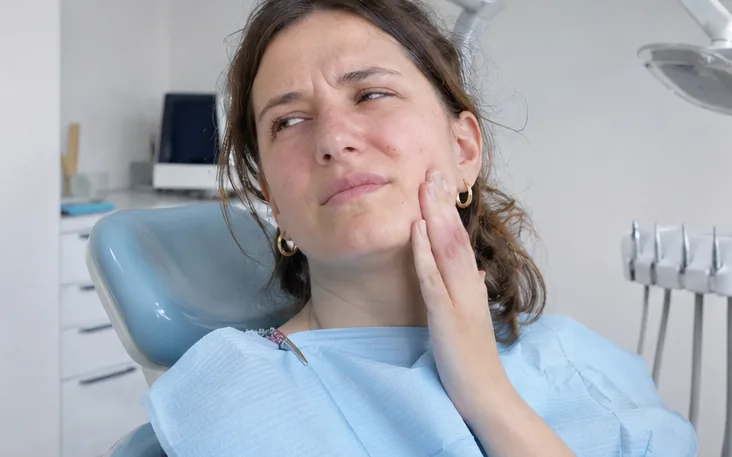
You leave the dental chair relieved it's over, and a few hours later your whole jaw aches. Maybe your mouth won't open as far as usual, or chewing on that side suddenly feels wrong. You're far from the only one, and most of the time there's a straightforward reason.
This guide explains the usual causes and how long each one normally lasts, along with what you can do at home. It also lists the signs that mean you should call your dentist back.
Key takeaways
Jaw pain after dental work usually comes from tired, overstretched chewing muscles, and sometimes from the injection, a changed bite or the treated tooth itself. In a Spanish study, one root canal session reduced mouth opening and made the jaw and neck muscles more tender straight afterwards (Albarova-Corral et al., 2023). Most of this settles within days to a couple of weeks.
- Holding your mouth open for a long time is a common trigger.
- A bite that feels high after a filling or crown is worth a quick recheck.
- Pain that gets worse after a few days, swelling or fever needs your dentist.
Is it normal for your jaw to hurt after a filling?
Yes, mild soreness is common, especially after a long appointment. A long session keeps your jaw open near the end of its range for a long time, and that can leave the chewing muscles tired and tender.
Researchers in Spain measured this in 29 people before and right after a single root canal session. Average mouth opening dropped from 46.3 to 41.9 millimetres, the jaw and neck muscles became more tender to pressure and neck movement decreased. The authors note the risk may be higher if your jaw was already limited before treatment (Albarova-Corral et al., 2023).
A large US study called OPPERA followed adults without jaw problems for nearly three years. People who had a jaw injury were almost four times as likely to develop TMD, and 80 per cent of those injuries came from yawning or prolonged mouth opening (Sharma et al., 2019). Dental visits were not analysed separately, but it shows that stretching your jaw open for a long time can strain it.
Why can't you open your mouth after a dental injection?
The injection that numbs your lower teeth passes close to a chewing muscle on the inside of your jaw. A US case report describes a woman who developed a clearly restricted opening the day after three of these injections and a routine filling, with pain in that muscle when she tried to open further. She had no swelling, swollen glands or fever (Wright, 2011).
The author describes treatment as heat, muscle stretches, painkillers or muscle relaxants and physical therapy, depending on how severe it is (Wright, 2011). A Lebanese case report adds repeated or misplaced injections as causes and notes that muscle-related restriction like this generally resolves within a few weeks (Khalifeh et al., 2024). If your opening is the main problem, our guide to limited mouth opening explains the normal range and a three-finger check.
Can a new filling or crown change your bite?
Yes, because a filling or crown that sits a fraction too high means one tooth touches first when you close, and you may only notice it once the numbness wears off, which can take several hours (NHS root canal, 2025).
A Chinese review looked at experiments where researchers deliberately placed small high spots on people's teeth. People with no history of TMD mostly adapted well. People with a TMD history developed clearly more clinical signs and reported stronger symptoms, such as an uncomfortable bite and trouble chewing (Xie et al., 2013).
My advice from practice is simple: if one side touches first or the new filling feels tall, call the practice instead of waiting a week, because checking it is usually quick. This is different from reshaping healthy teeth to treat TMD. The NIDCR says current evidence doesn't support a strong link between a misaligned bite and TMD, and advises against treatments that permanently change your bite (NIDCR, 2026).
Can dental work trigger a TMJ flare-up?
If you already have jaw problems, a long appointment can wake them up. The NHS lists pain around the jaw, ear and temple, clicking or popping and difficulty opening fully among the typical TMD symptoms (NHS TMD, 2023), and the evidence above suggests that people with a jaw history react more strongly to both long opening and bite changes (Albarova-Corral et al., 2023; Xie et al., 2013).
The reassuring part is that many TMDs last only a short time and go away on their own (NIDCR, 2026). Before your next appointment, let your dentist know about your jaw so you can agree on short breaks. Sometimes pain that feels like it's coming from a tooth actually starts in the jaw muscles, which can TMJ cause tooth pain? explains.
How long does jaw pain last after dental work?
That depends on what was done. After a root canal, a review of 72 studies found that 40 per cent of people still had pain at 24 hours and 11 per cent after a week, and by then it was mostly mild (Pak and White, 2011). The NHS says the area can feel swollen and sore but should get better in a couple of weeks (NHS root canal, 2025). Ongoing pain is uncommon: a meta-analysis found pain six months or more later in about 5 per cent of treated teeth (Nixdorf et al., 2010).
After wisdom tooth removal, pain and swelling usually start to improve after 1 or 2 days, while the jaw can stay sore and stiff for up to 2 weeks (NHS wisdom tooth removal, 2024). For restricted opening from many causes, most people feel better within two weeks (Cleveland Clinic, 2025). Our article on wisdom teeth and jaw pain covers that operation in more detail.
When pain comes back after an extraction
Pain that eases and then flares up again a few days after a tooth is pulled is a different story. Dry socket happens in about 1 in 20 extractions when the blood clot in the socket breaks down. It causes intense, throbbing pain within 1 to 3 days that can spread to the ear or eye on that side, often with bad breath or an unpleasant taste, and your dentist can treat it with a medicated dressing (healthdirect, 2026).
Try it: your after-the-dentist jaw check
I give people this check in physiotherapy after a dental appointment. It helps you tell an overworked jaw apart from something your dentist should look at. Start once the numbness has completely worn off.
- Sit upright and close your teeth together slowly. Notice whether one side or the new filling touches first.
- Open slowly as far as is comfortable and see how many fingers, stacked vertically, fit between your front teeth. Write the number down.
- Press gently with two fingers on the big chewing muscle in your cheek and on your temple. If that brings on the ache you've been feeling, the muscles are likely involved.
- Look at the treated area in a mirror and take your temperature. Swelling, a bad taste or a high temperature fit an infection better than tired muscles (NHS dental abscess, 2026).
- Repeat steps 2 and 3 each morning for three or four days. More fingers and less tenderness are good signs, and no change or a worse result means calling the practice.
Don't force your mouth open with your fingers, and stop if anything locks or the pain clearly rises.
What helps when your jaw hurts after the dentist?
In the moment
The NHS suggests soft foods such as pasta, omelettes and soup, paracetamol or ibuprofen, an ice pack or heat pack wrapped in a tea towel and gentle massage of the sore muscles. It also recommends not chewing gum, not biting food with your front teeth and not yawning too wide (NHS TMD, 2023). After an extraction, follow your dentist's wound advice first, including soft food and no smoking (NHS wisdom tooth removal, 2024). If you can't decide between heat and cold, does heat or ice help jaw pain? helps you choose.
Over the next few weeks
Once the acute soreness eases, gentle movement helps your jaw get its range back. The NIDCR recommends heat or cold together with exercises that gently stretch and strengthen the jaw muscles (NIDCR, 2026). Our TMJ exercises page shows simple ones to start with, always within a comfortable range.
How JawBuddy helps
JawBuddy is a digital companion for guided jaw exercises and self-management. If a dental appointment has left your jaw stiff, it can help you build gentle exercises and calmer jaw habits into your day while it recovers.
JawBuddy does not replace emergency care or an individual diagnosis from a qualified healthcare professional, so swelling, fever or a bite that feels wrong always goes back to your dentist first.
When should you see a doctor?
Right away: call 999 (UK), 911 (US) or 112 (EU) or go to the emergency department if:
- you find it hard to breathe, speak or swallow (NHS dental abscess, 2026),
- you have a lot of swelling in your mouth or find it hard to open your mouth along with signs of infection (NHS dental abscess, 2026),
- you have a swollen or painful eye or suddenly notice problems with your eyesight (NHS dental abscess, 2026).
Soon: call your dentist or 111 in the UK the same day if:
- you have bleeding that doesn't stop, or pain and swelling that are severe or getting worse and painkillers aren't helping (NHS wisdom tooth removal, 2024),
- the pain comes with a bad taste, a high temperature or feeling unwell (NHS wisdom tooth removal, 2024),
- intense pain starts or returns a few days after an extraction, or spreads towards your ear or eye (healthdirect, 2026),
- you can't eat or drink, or your jaw keeps locking (NHS TMD, 2023).
Book an appointment if:
- your jaw still hurts or won't open fully after about two weeks (Cleveland Clinic, 2025),
- your bite still feels off after the filling or crown,
- numbness or tingling in your tongue, lips or chin lasts after the anaesthetic should have worn off. This can come from nerve irritation and usually gets better, but it can last a few weeks or months (NHS wisdom tooth removal, 2024).
Your jaw usually bounces back
A sore jaw after the dentist is uncomfortable, but it's usually your muscles telling you they worked hard. Do the after-the-dentist check tomorrow morning and write the numbers down, so you can see your jaw recover or show your dentist what changed. For the bigger picture, visit our jaw pain overview.
Frequently asked questions
Is it normal for my jaw to hurt after a filling?+
Why can't I open my mouth after a dental injection?+
How long does jaw pain last after dental work?+
Can a new filling or crown cause jaw pain?+
When should I call the dentist about jaw pain after treatment?+
References
- Nixdorf DR, Moana-Filho EJ, Law AS, McGuire LA, Hodges JS, John MT. Frequency of persistent tooth pain after root canal therapy: a systematic review and meta-analysis. Journal of Endodontics 36(2), 224-230, 2010. ↗
- Wright EF. Medial pterygoid trismus (myospasm) following inferior alveolar nerve block: case report and literature review. General Dentistry 59(1), 64-67, 2011. ↗
- Pak JG, White SN. Pain prevalence and severity before, during, and after root canal treatment: a systematic review. Journal of Endodontics 37(4), 429-438, 2011. ↗
- Xie Q, Li X, Xu X. The difficult relationship between occlusal interferences and temporomandibular disorder: insights from animal and human experimental studies. Journal of Oral Rehabilitation 40(4), 279-295, 2013. ↗
- Sharma S, Wactawski-Wende J, LaMonte MJ, et al. Incident injury is strongly associated with subsequent incident temporomandibular disorder: results from the OPPERA study. Pain 160(7), 1551-1561, 2019. ↗
- Albarova-Corral I, Alonso-Ezpeleta O, Poc-Sola P, Cardiel-Sánchez S, et al. Restriction of mouth opening, reduction in pressure pain thresholds and activation of myofascial trigger points in mandibular and cervical regions after root canal therapy: a quasi-experimental study. Applied Sciences 13(9), 5246, 2023. ↗
- NHS. Temporomandibular disorder (TMD). National Health Service, UK. Page last reviewed 20 June 2023. ↗
- Khalifeh B, Simonian K, Houmani M, El-Outa A, Khalil W. Trismus following inferior alveolar nerve block: a case report. Cureus 16(11), e73394, 2024. ↗
- NHS. Wisdom tooth removal. National Health Service, UK. Page last reviewed 12 June 2024. ↗
- Cleveland Clinic. Trismus. Health Library, medically reviewed, last updated 22 July 2025. ↗
- NHS. Root canal treatment. National Health Service, UK. Page last reviewed 3 October 2025. ↗
- National Institute of Dental and Craniofacial Research (NIDCR). TMD (Temporomandibular Disorders). National Institutes of Health, accessed 14 November 2026. ↗
- healthdirect Australia. Dry socket. Accessed 14 November 2026. ↗
- NHS. Dental abscess. National Health Service, UK. Page last reviewed 18 March 2026. ↗
Continue reading
Why does my tongue have teeth marks on the sides?
A scalloped tongue has wavy teeth marks along its edges. A physio explains what the studies say about clenching, sleep apnea and thyroid problems, and when to get it checked.
Why are my teeth worn down?
Worn down teeth come from grinding, clenching, brushing or acid, usually several at once. A physio explains what your dentist checks and when worn teeth need treatment.
Why can't I open my mouth all the way?
Limited mouth opening explained by a physio: how wide a mouth normally opens, the common and rare causes, how clinicians examine it, a three-finger check you can do at home and what helps.
Why does my jaw hurt when I chew?
Jaw pain when chewing usually comes from the chewing muscles, the jaw joint or a tooth. A physio explains how to tell them apart, how to eat more gently and which signs need a doctor.