
Why are my teeth worn down?
Worn down teeth come from grinding, clenching, brushing or acid, usually several at once. A physio explains what your dentist checks and when worn teeth need treatment.

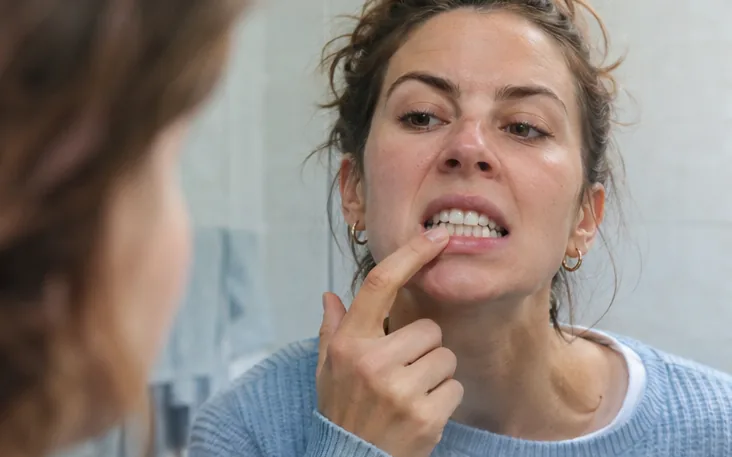
Maybe your dentist mentioned at your last checkup that your teeth look worn. Or you noticed in the mirror that your front teeth seem shorter and flatter than they used to. A finding like that can feel alarming when nobody explains what it means or whether something else is behind it.
Tooth wear is very common and well researched, so you're in good company. Below you'll find the different types of wear, how grinding and clenching fit in, what your dentist looks at and when treatment actually makes sense. As a physiotherapist I mostly see the jaw side of the problem, so I'll finish with a check you can do in your everyday life.
Key takeaways
Worn down teeth happen when enamel and the dentine underneath are lost over time. Experts separate mechanical wear, from tooth contact or brushing, and chemical wear, caused by acid, and in most people several causes work together (Wetselaar and Lobbezoo, 2016). Grinding and clenching are a common reason, but a good assessment looks at every factor.
- Tooth wear almost always has more than one cause, and the causes can make each other worse.
- Finding the cause, prevention and monitoring come first, and restorations follow only when needed.
- If you clench during the day, becoming aware of the habit is something you can work on yourself.
What is the difference between attrition, abrasion and erosion?
"Worn down" covers a few different processes. Attrition is the loss of enamel, dentine or filling material from tooth-to-tooth contact. Abrasion is loss from something other than tooth contact, such as brushing, and erosion is loss from chemicals without any bacteria involved (López-Frías et al., 2012). Attrition and abrasion count as mechanical wear, and erosion counts as chemical wear (Wetselaar and Lobbezoo, 2016).
You may also hear about abfraction, which describes wedge-shaped notches near the gumline that are thought to come from biting stress (López-Frías et al., 2012). A critical review from London found little evidence for it outside lab studies and sees it at most as a possible part of wear at the neck of the tooth. Brushing and acid are both discussed as causes of these notches (Bartlett and Shah, 2006).
What matters for you is that these types rarely show up alone. Because tooth wear has many causes, it can look very different from person to person, which makes it tricky to diagnose (Wetselaar and Lobbezoo, 2016).
Can grinding your teeth wear them down?
Yes. When you grind or clench, your teeth rub directly against each other, which is exactly what attrition describes. The NHS lists worn-down or broken teeth among the symptoms of teeth grinding and says they can become more sensitive, and that fillings and even teeth can be lost (NHS, 2026).
International experts don't treat grinding as a disease in itself. In otherwise healthy people, bruxism is seen as a behaviour that can be a risk factor for certain consequences, and this includes awake bruxism, meaning repeated or sustained tooth contact while you're awake (Lobbezoo et al., 2018). If you're unsure whether you grind at night, how do I know if I grind my teeth at night? goes through the signs.
Acid can make this worse. An Italian systematic review found signs that grinding and acid reflux often occur together and suggested that the teeth are then attacked mechanically and chemically at the same time (Nota et al., 2022). The European consensus also notes that mechanical wear is increased when acid has softened the tooth surface first (Loomans et al., 2017). So if your teeth are very worn, it's worth looking at both sides.
What else wears teeth down?
For erosion, a European consensus report names reflux, frequent vomiting, eating and drinking habits, and medicines and supplements. Foods and drinks with a low pH are major risk factors, calcium in the diet is protective, and acid fumes at work can also affect teeth (Carvalho et al., 2016).
Age plays a part as well. One systematic review estimated that severe tooth wear affects about 3 percent of people at 20 and 17 percent at 70, and several studies found men had more wear than women (Van't Spijker et al., 2009). Experts draw a line between normal, physiological wear and pathological wear that should be looked into (Loomans et al., 2017).
What does a dentist check for worn teeth?
Your dentist wants to know what kind of wear you have, how severe it is and where it comes from. A Dutch evaluation system breaks this into steps: recognising the problem and grading its severity, working out the likely causes and then tracking it over time (Wetselaar and Lobbezoo, 2016).
Typical patterns help with that. Cupped hollows on the chewing surfaces and fillings that stand higher than the tooth around them point to erosion. Sharp-edged wedge-shaped defects at the gumline fit abfraction, and exposed dentine is a notable finding in younger people (López-Frías et al., 2012). Expect questions about your diet, heartburn and medicines, because the European erosion consensus stresses checking every possible cause (Carvalho et al., 2016).
When do worn down teeth need treatment?
A finding of wear does not automatically mean drilling or building teeth up. The European consensus on severe tooth wear starts with diagnosis, prevention, counselling and monitoring. Whether to treat depends mostly on how severe the wear is, what effects it has and what you want, and restorations are best delayed as long as possible. When they are needed, the experts recommend a conservative, minimally invasive approach using adhesive (bonded) methods (Loomans et al., 2017).
For erosion, the consensus report recommends restorations to ease pain and sensitivity or restore looks and function, but only alongside preventive measures (Carvalho et al., 2016).
A night guard is worn while you sleep and is meant to protect your teeth from damage (NHS, 2026). The evidence on wear is thin, though. A systematic review by Cochrane Oral Health researchers found no reliable evidence on tooth wear in people who grind, so it is unclear how well splints slow wear (Riley et al., 2020). Our night guard alternative page covers the other options.
Try it: a tooth wear check before your dental appointment
Use this check to prepare if you've been told your teeth are worn. It doesn't replace an exam, but it gives you concrete observations to bring to your dentist.
- Stand at a well-lit mirror and smile wide. Look at the edges of your upper and lower front teeth and take a photo so you can compare later.
- Close your mouth loosely and slide your lower jaw slowly to the left and right. Notice whether flat spots on the top and bottom teeth line up exactly, because attrition comes from tooth-to-tooth contact (López-Frías et al., 2012).
- Run your tongue over your back teeth and feel for hollows or fillings that sit higher than the tooth around them, which is typical of erosion (López-Frías et al., 2012).
- For three days, check at random moments whether your teeth are touching. In physiotherapy we practise a resting position for this: lips closed, teeth apart and your tongue resting softly on the roof of your mouth.
- Write down how often you have acidic drinks, whether you get heartburn and whether your jaw or temples ache in the morning.
What can you do about worn down teeth?
In the moment
Skip chewing gum and hard foods while your teeth or jaw hurt. For jaw pain or swelling, the NHS suggests an ice pack wrapped in a tea towel for 20 to 30 minutes (NHS, 2026).
Long term
The NHS recommends finding ways to relax, regular exercise and good sleep habits for grinding, and your doctor can help with causes like stress and anxiety (NHS, 2026). For erosion, prevention targets the causes, such as diet, drinking habits and reflux, to slow things down (Carvalho et al., 2016). If you clench during the day, can you stop clenching your jaw during the day? shows practical ways to break the habit, and our teeth grinding page gives you the full picture.
How JawBuddy helps
JawBuddy is a digital companion for guided jaw exercises and self-management. The Therapy version is a medical device under the EU MDR and includes a daily tooth-contact check.
The app does not replace emergency care or an individual diagnosis from a qualified healthcare professional, so your dentist is the right person to assess the wear on your teeth.
When should you see a doctor?
Right away: go to the emergency room
- You have toothache and the area around your eye or your neck is swollen (NHS, 2024).
- Swelling in your mouth or neck makes it hard to breathe, swallow or speak (NHS, 2024).
Soon: book a dental appointment
- Toothache lasts more than 2 days or doesn't go away with painkillers (NHS, 2024).
- Toothache comes with a high temperature, pain when you bite, red gums, a bad taste or a swollen cheek or jaw (NHS, 2024).
- You grind your teeth and have tooth damage, sensitive teeth or pain in your jaw, face or ear (NHS, 2026).
If you often have heartburn or vomit frequently, see your doctor too, because reflux and vomiting are known causes of erosion (Carvalho et al., 2016).
Your teeth can be protected
Hearing that your teeth are worn can sound final, but it's mainly a prompt to look closer. Once the cause is clear, you and your dentist can do a lot to slow the wear down. Do the check from this article this week and take your notes to your next appointment. For how grinding, clenching and jaw problems fit together, start with our TMJ disorder guide.
Frequently asked questions
What causes worn down teeth?+
Is it normal for teeth to wear down with age?+
Does a night guard stop teeth from wearing down?+
Do worn down teeth always need fixing?+
References
- Bartlett DW, Shah P. A critical review of non-carious cervical (wear) lesions and the role of abfraction, erosion, and abrasion. Journal of Dental Research 85(4), 306-312, 2006. ↗
- Van't Spijker A, Rodriguez JM, Kreulen CM, Bronkhorst EM, Bartlett DW, Creugers NH. Prevalence of tooth wear in adults. International Journal of Prosthodontics 22(1), 35-42, 2009. ↗
- López-Frías FJ, Castellanos-Cosano L, Martín-González J, Llamas-Carreras JM, Segura-Egea JJ. Clinical measurement of tooth wear: Tooth wear indices. Journal of Clinical and Experimental Dentistry 4(1), e48-e53, 2012. ↗
- Wetselaar P, Lobbezoo F. The tooth wear evaluation system: a modular clinical guideline for the diagnosis and management planning of worn dentitions. Journal of Oral Rehabilitation 43(1), 69-80, 2016. ↗
- Carvalho TS, Colon P, Ganss C, et al. Consensus Report of the European Federation of Conservative Dentistry: Erosive tooth wear, diagnosis and management. Swiss Dental Journal 126(4), 342-346, 2016. ↗
- Loomans B, Opdam N, Attin T, et al. Severe Tooth Wear: European Consensus Statement on Management Guidelines. Journal of Adhesive Dentistry 19(2), 111-119, 2017. ↗
- Lobbezoo F, Ahlberg J, Raphael KG, et al. International consensus on the assessment of bruxism: Report of a work in progress. Journal of Oral Rehabilitation 45(11), 837-844, 2018. ↗
- Riley P, Glenny AM, Worthington HV, et al. Oral splints for temporomandibular disorder or bruxism: a systematic review. British Dental Journal 228(3), 191-197, 2020. ↗
- Nota A, Pittari L, Paggi M, Abati S, Tecco S. Correlation between Bruxism and Gastroesophageal Reflux Disorder and Their Effects on Tooth Wear. A Systematic Review. Journal of Clinical Medicine 11(4), 1107, 2022. ↗
- NHS. Toothache. National Health Service, UK. ↗
- NHS. Teeth grinding (bruxism). National Health Service, UK, last reviewed 8 April 2026. ↗
Continue reading
Why does my tongue have teeth marks on the sides?
A scalloped tongue has wavy teeth marks along its edges. A physio explains what the studies say about clenching, sleep apnea and thyroid problems, and when to get it checked.
Why does my jaw hurt after dental work?
Jaw pain after a filling, crown, root canal or extraction is common. A physio explains what causes it, how long it normally lasts, what helps and which signs mean you should call your dentist.
Why can't I open my mouth all the way?
Limited mouth opening explained by a physio: how wide a mouth normally opens, the common and rare causes, how clinicians examine it, a three-finger check you can do at home and what helps.
Why does my jaw hurt when I chew?
Jaw pain when chewing usually comes from the chewing muscles, the jaw joint or a tooth. A physio explains how to tell them apart, how to eat more gently and which signs need a doctor.