
Why does my jaw hurt when I chew?
Jaw pain when chewing usually comes from the chewing muscles, the jaw joint or a tooth. A physio explains how to tell them apart, how to eat more gently and which signs need a doctor.

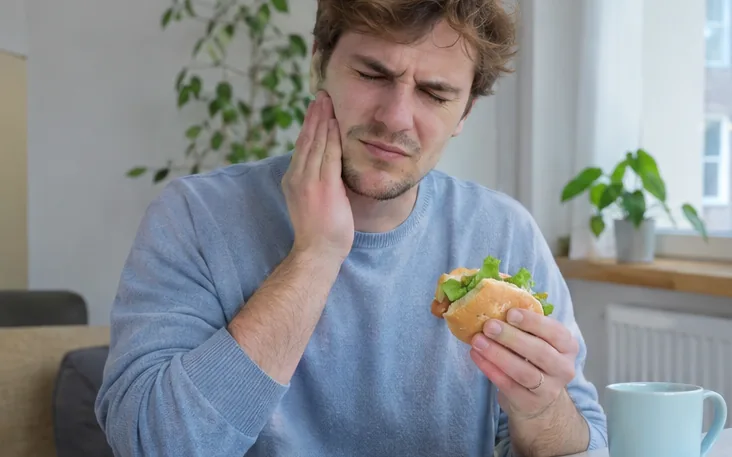
You bite into a crusty roll or work through a piece of steak, and something in your jaw starts to ache. For some people the pain shows up during the meal, for others it arrives afterwards or the next morning. The NHS notes that TMD pain may be worse when chewing (NHS TMD, 2023).
This article walks you through how to tell muscle, joint and tooth pain apart, which less common causes are worth knowing, and how to eat more comfortably while your jaw settles. You'll also get a one-week chewing diary you can start tonight.
Key takeaways
Jaw pain when chewing most often comes from the chewing muscles or the jaw joint, and sometimes from a tooth. The international diagnostic criteria for TMD require that jaw movement, chewing or habits such as clenching change the pain (Schiffman et al., 2014), and many people's TMD symptoms go away without treatment (NIDCR, 2026).
- A broad ache in the cheek or temple fits the muscles, while pain right in front of the ear fits the joint.
- Sharp pain when you bite down on one particular spot belongs with a dentist.
- Soft food, heat or cold, and dropping gum and nail biting are the first steps health services recommend.
Why does chewing make my jaw hurt?
Your chewing muscles in the cheek and temple close the jaw, and the two jaw joints just in front of your ears guide the movement. The DC/TMD, the criteria clinicians use worldwide, require that pain from these muscles or joints is changed by jaw movement, chewing or habits like clenching before they diagnose painful TMD (Schiffman et al., 2014).
A University at Buffalo analysis of 249 people with facial pain found that those whose pain changed with chewing also reported more limits on chewing in daily life (Alsuwailem et al., 2024). So if every meal feels like work, that fits the pattern clinicians look for.
Is it my muscle, my joint or a tooth?
The DC/TMD use the idea of "familiar pain". When a clinician presses on your jaw muscles or joint, or asks you to move your jaw, the test counts only if it brings on the same pain you know from everyday life (Schiffman et al., 2014). You can borrow that idea at home by paying close attention to where it hurts.
Muscle: The ache is spread out over the big chewing muscle in your cheek or over your temple. These are the two muscles a clinician presses on when checking for muscle pain (Schiffman et al., 2014). If your jaw muscles also feel stiff, why does my jaw feel tight? covers that.
Joint: The pain sits right in front of your ear, which is the area examined for joint pain (Schiffman et al., 2014). That answers the common question of why the jaw by your ear hurts when you chew. Noises matter here as well. The criteria link clicking or popping to a disc that slips and returns, and crunching or grating noises to wear in the joint (Schiffman et al., 2014). More on that in jaw clicking.
Tooth: The American Association of Endodontists describes cracked-tooth pain as erratic pain when chewing, sometimes exactly when you release the bite, often with sensitivity to hot or cold. Because the pain comes and goes, even a dentist can find it hard to pin down which tooth it is (AAE, 2026). The NHS lists pain when biting as a reason to see a dentist and names decay, abscesses, gum disease, cracked teeth and loose fillings among the causes (NHS toothache, 2024). If your teeth ache but the dentist finds nothing, read can TMJ cause tooth pain?
Why does my jaw ache the day after a big meal?
Unusually heavy jaw work can leave your chewing muscles sore in the same way a new workout leaves your legs sore. Researchers in Amsterdam gave 21 women without jaw problems intense jaw exercises to provoke delayed muscle soreness. After 24 hours their muscle pain and fatigue were higher and they mixed food less well when chewing, and after a week everything was back to baseline (Yoshida et al., 2012).
That study used exercises instead of meals, but it shows that jaw muscles can react hours later and recover within a week. Soreness that is already there when you wake up, before you have eaten anything, can point towards clenching or grinding at night, which why does my jaw hurt when I wake up? explains.
Can teeth grinding cause pain when chewing?
It can. The NHS lists teeth grinding among the causes of TMD, whose pain may be worse when you chew, and also among the causes of toothache (NHS TMD, 2023; NHS toothache, 2024). If you suspect you grind or clench, our teeth grinding page explains how to spot it and what helps.
What else can make eating painful?
Two less common causes have little to do with your jaw muscles or joint but show up mainly at mealtimes. A salivary gland stone can cause intense pain during meals when it fully blocks a gland, usually lasting one to two hours, and most stones form in the glands under the tongue (NHS salivary stones, 2023).
The second cause is more serious. Temporal arteritis, also called giant cell arteritis, is an inflammation of blood vessels. The NHS lists jaw pain while eating or talking among its main symptoms, together with frequent severe headaches, a tender scalp or temple and vision problems, and warns it can lead to stroke and blindness if not treated quickly (NHS temporal arteritis, 2023). A review in JAMA found that jaw pain on chewing was one of only two history features that clearly raised the likelihood of the disease in people referred for a biopsy (Smetana & Shmerling, 2002). Israeli dental researchers describe how it can be mistaken for TMD and advise thinking of it in older adults with face pain (Reiter et al., 2009).
Try it: your chewing diary
I ask people in physiotherapy to keep this diary because patterns show up within a few days. It builds on the "familiar pain" idea above. Keep it for one week.
- After each meal, write down what you ate and whether it was soft, chewy or hard.
- Point to the sore spot with one finger and note it: cheek, temple, in front of the ear or one particular tooth.
- Record when the pain starts, whether on the first bite, after a few minutes of chewing, after the meal or the next day.
- Note any clicking or grating, and whether a tooth reacts to cold, heat or letting go of the bite.
- Track how often you chew gum, chew pens or catch yourself clenching between meals.
Don't bite on hard objects to provoke pain. If one tooth keeps standing out, take your notes to a dentist.
What helps when chewing hurts?
In the moment
The NHS recommends soft foods such as pasta, omelettes and soup, not biting food with your front teeth, massaging the sore muscles and trying relaxation techniques. Keep your teeth apart when you aren't eating, and avoid gum, pen tops, nail biting and very wide yawns. For heat, it suggests a wrapped hot water bottle for 15 to 20 minutes twice a day, and for cold, frozen peas in a tea towel for no more than 5 minutes at a time, whichever feels better (NHS TMD, 2023). Which of the two suits you is covered in does heat or ice help jaw pain?, and if gum is part of your day, see does chewing gum make TMJ worse?
Over the next few weeks
As a physio, I suggest soft food for the few painful days and then a gradual return to firmer textures. An international panel of TMD experts agreed that self-management rests on education, jaw exercises, self-massage, heat or cold, dietary advice and spotting and avoiding jaw-straining habits (Durham et al., 2016). The NIDCR also recommends gentle jaw stretching and strengthening alongside heat or cold (NIDCR, 2026). Our TMJ exercises page is a good place to start.
How JawBuddy helps
JawBuddy is a digital companion for guided jaw exercises and self-management. JawBuddy Therapy also includes a daily tooth contact check that helps you notice clenching during the day.
It does not replace emergency care or an individual diagnosis from a qualified healthcare professional, so a painful tooth always goes to a dentist first.
When should you see a doctor?
Right away: call 999 (UK), 911 (US) or 112 (EU) if:
- you have chest pain spreading to your arms, neck or jaw (NHS heart attack, 2026),
- swelling makes it hard to breathe, swallow or speak, or spreads towards your eye or neck (NHS toothache, 2024).
Soon: get an urgent GP appointment or call 111 the same day if:
- you have new jaw pain when eating or talking together with severe headaches or a tender scalp or temple (NHS temporal arteritis, 2023),
- you notice double vision or vision loss, which needs a same-day eye assessment (NHS temporal arteritis, 2023),
- you can't eat or drink, can't open your mouth fully or your jaw locks (NHS TMD, 2023).
Book a dentist or GP if:
- a toothache lasts more than two days, doesn't ease with painkillers, or comes with fever or pain when biting (NHS toothache, 2024),
- you keep getting pain or swelling under your tongue at mealtimes, or the area turns red, painful or feverish (NHS salivary stones, 2023),
- chewing still hurts after a few weeks of going easy on your jaw. A GP can refer you to a dentist or a physiotherapist for jaw exercises and massage (NHS TMD, 2023).
You can enjoy your food again
Pain at every meal wears you down, because eating is part of every day. Often the cause is tired muscles or an irritated joint, and many people's TMD symptoms settle without treatment (NIDCR, 2026). Start your chewing diary with tonight's dinner, and for the bigger picture visit our jaw pain overview or the TMJ disorder guide.
Frequently asked questions
Why does my jaw hurt when I chew?+
Why does my jaw by my ear hurt when I chew?+
Why does my jaw ache the day after eating something chewy?+
Can teeth grinding cause pain when chewing?+
When is jaw pain while eating an emergency?+
References
- Smetana GW, Shmerling RH. Does this patient have temporal arteritis? JAMA 287(1), 92-101, 2002. ↗
- Reiter S, Winocur E, Goldsmith C, Emodi-Perlman A, Gorsky M. Giant cell arteritis misdiagnosed as temporomandibular disorder: a case report and review of the literature. Journal of Orofacial Pain 23(4), 360-365, 2009. ↗
- Yoshida E, Lobbezoo F, Fueki K, Naeije M. Effects of delayed-onset muscle soreness on masticatory function. European Journal of Oral Sciences 120(6), 526-530, 2012. ↗
- Schiffman E, Ohrbach R, Truelove E, et al. Diagnostic Criteria for Temporomandibular Disorders (DC/TMD) for Clinical and Research Applications. Journal of Oral & Facial Pain and Headache 28(1), 6-27, 2014. ↗
- Durham J, Al-Baghdadi M, Baad-Hansen L, et al. Self-management programmes in temporomandibular disorders: results from an international Delphi process. Journal of Oral Rehabilitation 43(12), 929-936, 2016. ↗
- NHS. Temporomandibular disorder (TMD). National Health Service, UK. Page last reviewed 20 June 2023. ↗
- NHS. Salivary gland stones. National Health Service, UK. Page last reviewed 14 August 2023. ↗
- NHS. Temporal arteritis (giant cell arteritis). National Health Service, UK. Page last reviewed 14 August 2023. ↗
- Alsuwailem R, Crow H, Gonzalez Y, McCall WD, Ohrbach R. The associations of the diagnostic criterion pain modified by function with functional limitation and behavioral frequency. Journal of Oral & Facial Pain and Headache 38(3), 46-57, 2024. ↗
- NHS. Toothache. National Health Service, UK. Page last reviewed 1 July 2024. ↗
- National Institute of Dental and Craniofacial Research (NIDCR). TMD (Temporomandibular Disorders). National Institutes of Health. Last reviewed September 2026. ↗
- American Association of Endodontists (AAE). Cracked Teeth. Patient information, accessed 13 November 2026. ↗
- NHS. Heart attack. National Health Service, UK. Page last reviewed 31 March 2026. ↗
Continue reading
Why does my tongue have teeth marks on the sides?
A scalloped tongue has wavy teeth marks along its edges. A physio explains what the studies say about clenching, sleep apnea and thyroid problems, and when to get it checked.
Why are my teeth worn down?
Worn down teeth come from grinding, clenching, brushing or acid, usually several at once. A physio explains what your dentist checks and when worn teeth need treatment.
Why does my jaw hurt after dental work?
Jaw pain after a filling, crown, root canal or extraction is common. A physio explains what causes it, how long it normally lasts, what helps and which signs mean you should call your dentist.
Why can't I open my mouth all the way?
Limited mouth opening explained by a physio: how wide a mouth normally opens, the common and rare causes, how clinicians examine it, a three-finger check you can do at home and what helps.