
Why does my tongue have teeth marks on the sides?
A scalloped tongue has wavy teeth marks along its edges. A physio explains what the studies say about clenching, sleep apnea and thyroid problems, and when to get it checked.

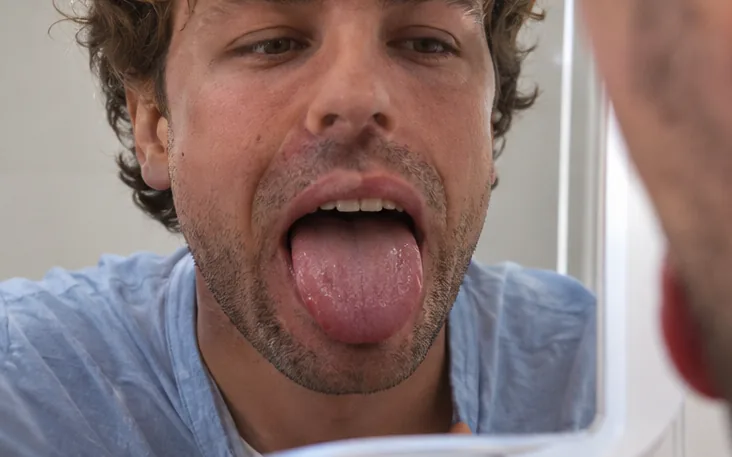
You stick your tongue out in the mirror and notice a wavy edge along the sides, as if your teeth left a print in it. Maybe you searched it and found everything from "you grind your teeth" to thyroid problems and sleep apnea. That is a lot to take in from one small detail, and plenty of people go through exactly this search.
In this article I go through what a scalloped tongue is, what the research says about clenching, sleep apnea and other causes, and where that research runs out. You also get a short mirror check you can do today and a clear list of when to get it looked at.
Key takeaways
A scalloped tongue has wavy indentations along its sides where it rests against your teeth. It usually happens when the tongue is wide or swollen and presses into the teeth (Cleveland Clinic, 2025). The marks can go along with clenching or sleep apnea, but on their own they do not diagnose either.
- Studies on tongue scalloping are observational, so they show links rather than causes.
- If you also snore loudly, stop breathing in your sleep or feel exhausted every day, get checked for sleep apnea.
- A tongue that suddenly swells up is an emergency, while wavy edges without other symptoms can wait for a normal appointment.
What is a scalloped tongue?
Clinicians call it a scalloped, crenated or indented tongue. Cleveland Clinic describes rippling along the edges of the tongue that often shows up when the tongue swells and pushes against the teeth, and says the scalloping is not harmful by itself, although it can be a sign of an underlying condition (Cleveland Clinic, 2025).
The shape of your tongue matters more than you might expect. A small Japanese study measured tongue pressure against the back teeth in 24 people during rest, clenching and swallowing. People with and without tongue marks pressed with similar force. What differed was how wide the tongue was at rest, and the authors saw tongue width as a key factor in how the marks form (Yanagisawa et al., 2007). So some people simply have a tongue that fills more of the space between their teeth.
Do teeth marks on your tongue mean you clench your jaw?
They are one of the clues dentists look for, but they are not proof. A recent review of sleep bruxism lists tongue indentations next to worn teeth, an enlarged chewing muscle and jaw joint noises as typical findings, and advises dentists to record a scalloped tongue, a white line on the inner cheek and lip impressions during the exam (Balasubramaniam et al., 2026).
How reliable that clue is has only been tested a few times. An older review of 113 patient records concluded that tongue indentations point to clenching and deserve a routine look (Sapiro, 1992). A study of 244 bank employees in Japan found that tongue marks and cheek ridges were linked to sex, age and bite height, but not to whether people knew they clenched or ground their teeth (Piquero et al., 1999).
The most useful study measured jaw muscle activity at night with a portable device in 50 young adults. Signs like tooth wear, tooth sensitivity and marks on the tongue and cheeks missed a good share of the people who were actually grinding, and the authors concluded these signs can only be used for screening, not as a valid diagnosis (Grossi et al., 2024). For the other clues that point to night grinding, read how do I know if I grind my teeth at night?
Can a scalloped tongue be a sign of sleep apnea?
The research here is a bit larger, though still observational. In a US ear, nose and throat clinic study of 61 patients, 25 of whom had an overnight sleep study, tongue scalloping picked up about half of the people with obstructive sleep apnea. It was fairly specific for oxygen drops during the night, and the authors concluded that in high-risk patients tongue scalloping was predictive of sleep problems (Weiss et al., 2005).
A Japanese community study of 1,130 adults found a link too. Oxygen levels were measured with a finger clip for one night. People with moderate to severe scalloping had about 2.4 times the odds of frequent oxygen drops compared with people without it, and the link was stronger in people who were overweight. Mild scalloping showed no clear link (Tomooka et al., 2017). In an Indian study of 1,261 mostly overweight, high-risk adults, 39.6 percent of people with sleep apnea had a scalloped tongue, and so did 20.5 percent of people without it (Patel et al., 2025).
The NHS lists the main signs of sleep apnea as breathing that stops and starts during sleep, gasping, snorting or choking noises, waking up a lot and loud snoring, plus feeling very tired, struggling to concentrate, mood swings and morning headaches during the day (NHS, sleep apnoea, 2026). How breathing and grinding connect is covered in can sleep apnea cause teeth grinding?
What else can cause teeth marks on the sides of your tongue?
Cleveland Clinic lists allergies and infections, inflammatory conditions such as Sjögren's syndrome, thyroid problems (especially an underactive thyroid), teeth grinding or jaw clenching, and low levels of vitamin B12, iron, niacin or riboflavin (Cleveland Clinic, 2025). The page also mentions dehydration. It does not cite studies for these, and good research on dehydration and vitamins in this context is thin, so treat them as questions for your doctor.
An underactive thyroid usually shows up with more than a wavy tongue. The NHS names tiredness, feeling cold, weight gain, constipation, dry skin and low mood, and says symptoms tend to develop slowly (NHS, underactive thyroid, 2025). If several of those sound familiar, a simple blood test at your doctor's office can rule it in or out.
Try it: a three-minute mirror check
This is a quick check I like people to do before an appointment, so they arrive with clear observations. It does not replace an examination.
- Stand at a mirror in good light and let your tongue rest outside your mouth without pushing it out hard. Note whether the waves show on both sides or only one.
- Gently pull one cheek aside with a clean finger and look along the inside for a white line at the level where your teeth meet.
- Over one day, check in now and then on whether your teeth are touching when you aren't eating. The NHS says your teeth should be apart except when you eat (NHS, TMD, 2023).
- Ask whoever sleeps near you whether you snore loudly, seem to stop breathing or grind your teeth.
- Take a photo of your tongue and write down any jaw pain, daytime tiredness or feeling cold. Bring this to your dentist or doctor.
What helps a scalloped tongue go away?
Cleveland Clinic says treatment depends on the cause and that treating the cause usually helps the scalloping go away (Cleveland Clinic, 2025).
In the moment
If you catch yourself clenching, let your teeth part. A relaxed resting position helps here: lips lightly together, teeth apart and your tongue resting softly on the roof of your mouth without pressing. For tight jaw muscles, the NHS suggests soft food, a warm or cold pack wrapped in a cloth and gently massaging the jaw muscles (NHS, TMD, 2023).
Long term
When clenching or grinding is behind it, building awareness of the habit during the day is a sensible first step, and the NHS advises against chewing gum, pen chewing and nail biting (NHS, TMD, 2023). Practical ways to do that are in can you stop clenching your jaw during the day? If sleep apnea or a thyroid problem might be involved, you need a medical diagnosis first. Cleveland Clinic gives examples such as a mouth guard for grinding, treatment for thyroid problems from your doctor and a CPAP machine for sleep apnea (Cleveland Clinic, 2025). Our TMJ exercises page shows gentle exercises for the jaw and chewing muscles.
How JawBuddy helps
JawBuddy is a digital companion for guided jaw exercises and self-management. The Therapy version also includes a daily tooth-contact check that helps you notice clenching during the day.
The app does not replace emergency care or an individual diagnosis from a qualified healthcare professional. Whether your tongue marks come from clenching, breathing or something else is a question for your dentist or doctor.
When should you see a doctor?
Right away: call emergency services or go to the emergency room
- Your tongue, lips, mouth or throat suddenly swell up (NHS, angioedema, 2026).
- You are struggling to breathe, your throat feels tight or you can hardly swallow (NHS, angioedema, 2026).
- Your tongue or lips turn blue, grey or pale (NHS, angioedema, 2026).
Soon: book a doctor or dentist appointment
- You've been told your breathing stops in your sleep, you gasp or choke at night, or you always feel very tired during the day (NHS, sleep apnoea, 2026).
- A mouth ulcer hasn't healed after three weeks, or you notice a lump or a red or white patch in your mouth (NHS, mouth cancer, 2023).
- You can't eat or drink because of jaw pain, or you can't open or close your mouth properly (NHS, TMD, 2023).
- You feel constantly tired, cold and are gaining weight without a clear reason (NHS, underactive thyroid, 2025).
Cleveland Clinic also says to let your provider know about ripples along your tongue even when they don't hurt (Cleveland Clinic, 2025).
A look in the mirror is a good place to start
A scalloped tongue is a clue you can follow up calmly. If you write down what you notice in the mirror check and take it to your appointment, you and your dentist or doctor will get to the cause faster. If clenching or grinding turns out to be part of it, our teeth grinding page walks you through what helps next.
Frequently asked questions
What causes a scalloped tongue?+
Is a scalloped tongue a sign of teeth clenching?+
Can a scalloped tongue mean sleep apnea?+
Is a scalloped tongue harmful?+
References
- Sapiro SM. Tongue indentations as an indicator of clenching. Clinical Preventive Dentistry 14(2), 21-24, 1992. ↗
- Piquero K, Ando T, Sakurai K. Buccal mucosa ridging and tongue indentation: incidence and associated factors. Bulletin of Tokyo Dental College 40(2), 71-78, 1999. ↗
- Weiss TM, Atanasov S, Calhoun KH. The association of tongue scalloping with obstructive sleep apnea and related sleep pathology. Otolaryngology Head and Neck Surgery 133(6), 966-971, 2005. ↗
- Yanagisawa K, Takagi I, Sakurai K. Influence of tongue pressure and width on tongue indentation formation. Journal of Oral Rehabilitation 34(11), 827-834, 2007. ↗
- Tomooka K, Tanigawa T, Sakurai S, et al. Scalloped tongue is associated with nocturnal intermittent hypoxia among community-dwelling Japanese: the Toon Health Study. Journal of Oral Rehabilitation 44(8), 602-609, 2017. ↗
- NHS. Temporomandibular disorder (TMD). National Health Service, UK. ↗
- NHS. Mouth cancer: symptoms. National Health Service, UK. ↗
- Grossi ML, Castillo LO, Pattussi MP, Pinto GM, Filho RT. Validity between signs and symptoms of sleep bruxism against a validated portable electromyographic device. Journal of Clinical and Experimental Dentistry 16(11), e1354-e1360, 2024. ↗
- Cleveland Clinic. Scalloped Tongue. Health Library, last reviewed 13 May 2025. ↗
- Patel LB, Patel MM, Patel DK, et al. Tongue scalloping as a sign of obstructive sleep apnea syndrome: Clinical and polysomnographic insights. Lung India 42(4), 299-303, 2025. ↗
- NHS. Underactive thyroid (hypothyroidism): symptoms. National Health Service, UK. ↗
- Balasubramaniam R, Manfredini D, Guan G. Sleep Bruxism: A Narrative Review of Current Concepts, Mechanisms, and Clinical Implications. Journal of the Royal Society of New Zealand 56(2), e70046, 2026. ↗
- NHS. Sleep apnoea. National Health Service, UK. ↗
- NHS. Angioedema. National Health Service, UK. ↗
Continue reading
Why are my teeth worn down?
Worn down teeth come from grinding, clenching, brushing or acid, usually several at once. A physio explains what your dentist checks and when worn teeth need treatment.
Why does my jaw hurt after dental work?
Jaw pain after a filling, crown, root canal or extraction is common. A physio explains what causes it, how long it normally lasts, what helps and which signs mean you should call your dentist.
Why can't I open my mouth all the way?
Limited mouth opening explained by a physio: how wide a mouth normally opens, the common and rare causes, how clinicians examine it, a three-finger check you can do at home and what helps.
Why does my jaw hurt when I chew?
Jaw pain when chewing usually comes from the chewing muscles, the jaw joint or a tooth. A physio explains how to tell them apart, how to eat more gently and which signs need a doctor.