
Should I see a dentist or a physiotherapist for jaw pain?
Not sure whether your jaw pain belongs with a dentist or a physio? A physiotherapist explains what each one does for TMD, who to see first and when you need a doctor instead.

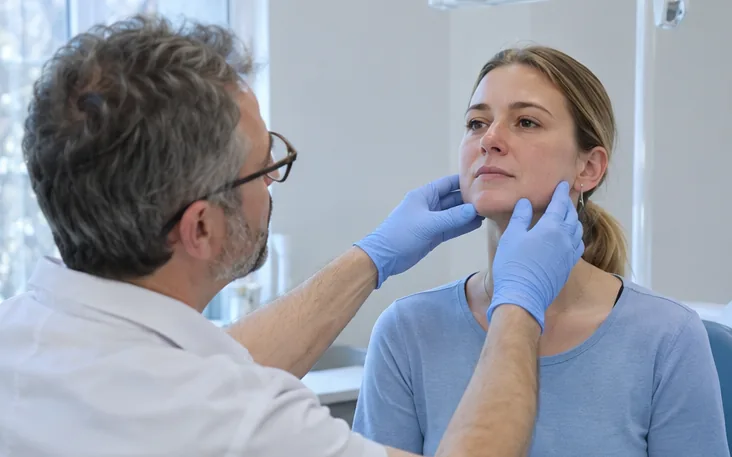
If you do not know why your jaw hurts, see a dentist or GP first, because a doctor or dentist needs to rule out other causes before diagnosing a temporomandibular disorder (NIDCR, 2026). Once that diagnosis is clear, a physiotherapist is often the better person for ongoing treatment, since supervised jaw exercise and manual therapy are strongly recommended for chronic TMD pain (Busse et al., 2023). Many people end up seeing both, the dentist for teeth and splints and the physiotherapist for the muscles and joint.
Both answers can be right. In this article I explain what each profession does for jaw pain, who to see first in which situation and when you need a doctor instead.
Key takeaways
If you do not know why your jaw hurts, see a dentist or GP first. A doctor or dentist takes your history, examines the jaw and rules out other causes before diagnosing a temporomandibular disorder (NIDCR, 2026). Once the diagnosis is clear, a physiotherapist is often the right person for ongoing treatment of the muscles and joint.
- A dentist rules out tooth causes, diagnoses TMD and can fit a splint, though the evidence for splints reducing TMD pain is limited (NIDCR, 2026).
- A physiotherapist uses exercise and hands-on treatment, which a BMJ guideline strongly recommends for chronic TMD pain (Busse et al., 2023).
- Chest pain spreading to your jaw is an emergency and needs 999, 911 or 112 straight away (NHS heart attack, 2026).
What does a dentist do for jaw pain?
Your dentist's first job is to find out whether a tooth is to blame. Toothache can come from decay, a broken tooth, a loose filling or an infection, and jaw pain with swelling or a bad taste can point to a dental problem (NHS toothache, 2024). A clinical review for physicians says tooth problems are a common cause of facial pain and suggests looking at the jaw joint, chewing muscles and other causes when no clear dental source turns up (Abboud et al., 2026).
If the teeth look fine, a dentist can examine the jaw itself. There is no single accepted test for TMD, so the diagnosis rests on your symptoms, your medical history and an examination of tenderness, clicking and how your jaw moves, sometimes with imaging (NIDCR, 2026). For tooth pain that might be coming from the jaw, read can TMJ cause tooth pain.
Dentists are also the ones who make splints. The NIDCR says a splint can help with habits like clenching, that evidence for pain relief is limited, and that you should check it is not designed to permanently change your bite (NIDCR, 2026). A systematic review by Cochrane Oral Health found no evidence that splints reduced pain when all types of TMD were pooled together, with very low-certainty evidence overall (Riley et al., 2020). A splint can still be part of the plan, especially if you grind at night, and our night guard alternative page explains the options.
What does a physiotherapist do for TMJ?
A physiotherapist treats the jaw as a joint with muscles around it, much like a knee or a shoulder. The NIDCR describes physical therapy as maintaining or restoring movement and function, and manual therapy as a therapist using their hands to stretch the soft tissues and muscles around the joint. It says research suggests manual therapy can improve function and relieve pain (NIDCR, 2026).
The strongest support comes from a 2023 clinical practice guideline in the BMJ on chronic TMD pain lasting three months or more. Its panel strongly recommended therapist-assisted mobilisation, manual trigger point therapy, supervised postural exercise, supervised jaw exercise and stretching, and usual care such as home exercises, reassurance and education (Busse et al., 2023). The same panel made a conditional recommendation against reversible occlusal splints (Busse et al., 2023).
Exercise sits at the centre of most physio programmes. A meta-analysis of 16 randomised trials with 812 people found exercise therapy reduced pain and improved how wide people could open their mouth, and adding exercise to a splint worked better than a splint alone (Idáñez-Robles et al., 2023). In my sessions that means jaw movement control, relaxing the chewing muscles, neck and posture work, and a home plan you can do between appointments. You can see examples on our TMJ exercises page.
Who should you see first?
The NHS suggests seeing a GP first for jaw pain, or a dentist if teeth grinding might be the issue. A GP may refer you to a physiotherapist for advice about jaw exercises and massage, and to a specialist in joint problems if that does not help (NHS TMD, 2023). Here is how I would think about it.
| Dentist | Physiotherapist | |
|---|---|---|
| Main role | Rules out tooth causes, examines the jaw, diagnoses TMD (NIDCR, 2026) | Treats jaw muscles and joint with exercise and manual therapy (Busse et al., 2023) |
| Typical tools | Examination, imaging if needed, splints | Mobilisation, trigger point therapy, jaw and posture exercises, home plan |
| See first if | Pain sits in one tooth, gums are swollen, teeth are worn or chipped | Tooth causes are ruled out and pain changes with chewing, yawning or clenching |
Go to a dentist first if your pain sits in or around one tooth, a tooth is sensitive to hot, cold or biting, your gums are swollen, or you notice worn or chipped teeth from grinding. Go to a doctor first if you also have fever, frequent or severe headaches, vision problems, or symptoms outside the jaw that worry you (NHS TMD, 2023).
A physiotherapist is a good next step once tooth problems and other causes have been ruled out and your pain is linked to chewing, yawning, clenching or jaw movement. In some countries you can book a physio directly, but a dentist or GP should have checked the cause first if anything feels unusual.
Why do dentists and physiotherapists often work together?
TMD covers more than 30 conditions affecting the jaw joint and the muscles that move it, and the NIDCR recommends starting with conservative treatments that do not permanently change your teeth, bite or joint (NIDCR, 2026). That fits a shared approach where the dentist handles the teeth, the diagnosis and any splint, while the physio works on movement, muscles and habits.
Self-management is part of both jobs. A 2026 meta-analysis of 47 trials found no consistent advantage or disadvantage for education and self-management programmes compared with other non-surgical treatments for TMD, although other treatments may relieve pain a little more in the short term, and the certainty of all this evidence was low to very low (Ferland et al., 2026). In practice I see the best progress when you know what to do between appointments, whichever professional you start with.
Try it: a quick check before your appointment
This is the short check I run in physiotherapy before deciding whether someone also needs a dentist. It does not replace an examination.
- Press each tooth area gently with a fingertip and bite softly on a cotton bud. Pain in one specific tooth points towards your dentist.
- Put two fingertips on your cheek muscles, clench lightly, then relax and press the same spot. Tenderness here points towards the chewing muscles.
- Place a fingertip just in front of your ear and open and close your mouth slowly. Note any clicking, catching or pain.
- Open as wide as is comfortable and check whether your jaw moves straight or shifts to one side.
- Write down when the pain is worst, such as on waking, after chewing or at the end of a workday.
Bring your notes to whoever you see first. If the pain is clearly in one tooth, start with the dentist. If it is mostly muscle tenderness and movement problems, a physiotherapist can help once other causes have been checked.
How JawBuddy helps
JawBuddy is a digital companion for guided jaw exercises and self-management. Between appointments, it can support the home programme your dentist or physiotherapist gives you, so the exercises keep going on the days you are not in the practice.
JawBuddy does not replace emergency care or an individual diagnosis from a qualified healthcare professional.
When should you see a doctor?
Right away: call 999 in the UK, 911 in the US or 112 in the EU if you have:
- chest pain that spreads to your arms, neck or jaw, especially with sweating, shortness of breath or feeling sick (NHS heart attack, 2026),
- swelling around your eye or neck, or swelling that makes it hard to breathe, swallow or speak (NHS toothache, 2024).
Soon: get an urgent GP appointment or call 111 (or your doctor) if:
- you cannot eat or drink, have difficulty opening your mouth fully or your jaw is locking (NHS TMD, 2023),
- you have frequent, severe headaches or vision problems such as double vision (NHS TMD, 2023).
See a dentist soon if toothache lasts more than 2 days, does not settle with painkillers, or comes with fever, pain when biting, red gums or a bad taste in your mouth (NHS toothache, 2024). If your jaw gets stuck, read our guide to a locked jaw.
You do not have to figure it out alone
The right first appointment depends on where your pain comes from, and that is fine to not know yet. Do the check above today, book whichever fits best and ask whether a dentist and physiotherapist can share your care.
For the full picture, read our TMJ disorder guide or start with the jaw pain overview.
Frequently asked questions
Should I see a dentist or a physiotherapist for jaw pain?+
Can a physiotherapist help with TMJ?+
Does a dentist treat TMJ?+
What kind of doctor do I see for my jaw?+
References
- Riley P, Glenny AM, Worthington HV, et al. Oral splints for temporomandibular disorder or bruxism: a systematic review. British Dental Journal 228(3), 191-197, 2020. ↗
- NHS. Temporomandibular disorder (TMD). National Health Service, UK. Page last reviewed 20 June 2023. ↗
- Busse JW, Casassus R, Carrasco-Labra A, et al. Management of chronic pain associated with temporomandibular disorders: a clinical practice guideline. BMJ 383, e076227, 2023. ↗
- Idáñez-Robles AM, Obrero-Gaitán E, Lomas-Vega R, et al. Exercise therapy improves pain and mouth opening in temporomandibular disorders: A systematic review with meta-analysis. Clinical Rehabilitation 37(4), 443-461, 2023. ↗
- NHS. Toothache. National Health Service, UK. Page last reviewed 1 July 2024. ↗
- National Institute of Dental and Craniofacial Research (NIDCR). TMD (Temporomandibular Disorders). National Institutes of Health. Last reviewed September 2026. ↗
- Abboud WA, Tunis TS, Peleg O, et al. Differential Diagnosis of Orofacial and Jaw Pain: A Clinical Review for Physicians. Rambam Maimonides Medical Journal 17(4), e0023, 2026. ↗
- Ferland G, Vincent R, Desmeules F, et al. Patient Education and Self-Management in Adults With Temporomandibular Disorders: Results From a Systematic Review With Meta-Analysis. Journal of Oral Rehabilitation 53(7), 1394-1408, 2026. ↗
- NHS. Heart attack. National Health Service, UK. Page last reviewed 31 March 2026. ↗
Continue reading
Masseter Botox vs jaw exercises: which works better for clenching?
Botox in the masseter can lower bite force and pain for a few months, while jaw exercises carry a strong guideline recommendation for chronic TMD pain. What the research says, side by side.
Are jaw exercises as effective as a night guard?
A night guard protects your teeth but does not stop grinding. Exercises target pain and movement. What the BMJ guideline and Cochrane reviews say, and when to use both
JawBuddy vs BruxControl vs Unclench: which app is best for jaw clenching?
A physio compares JawBuddy, BruxControl and Unclench for jaw clenching using each developer's own listing: features, platforms, who built them and who each app suits.
Is there an alternative to CalmJaw?
Looking for a CalmJaw alternative? A physio compares CalmJaw with other TMJ apps, explains what the research says about relaxation and exercise, and helps you pick.