
Masseter Botox vs jaw exercises: which works better for clenching?
Botox in the masseter can lower bite force and pain for a few months, while jaw exercises carry a strong guideline recommendation for chronic TMD pain. What the research says, side by side.

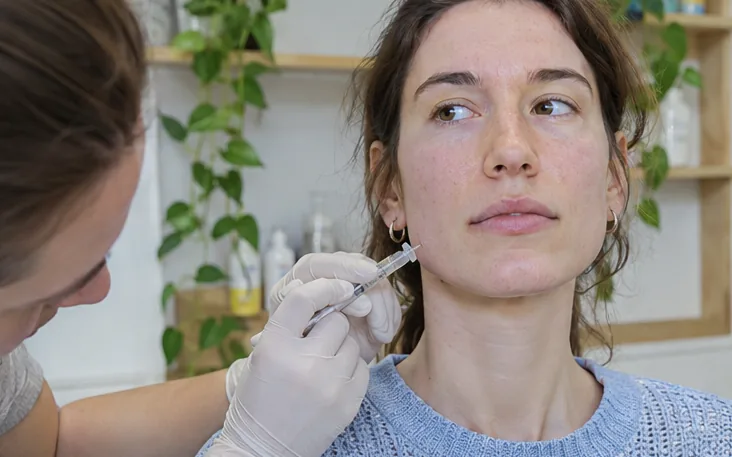
Your dentist has pointed out worn teeth, your jaw feels tight by mid-afternoon, and someone has mentioned that Botox in the masseter could switch the clenching off. Before you book an injection you want to know whether jaw exercises could do the same job, or whether you would just be wasting months.
You are far from the only person weighing this up, and the research gives a clearer answer than most clinic websites do. I will walk you through what Botox and exercises each do to a clenching jaw, how long the effects last and what the main guideline recommends, so you can make the call with your dentist or doctor.
Key takeaways
No trial in the reviews I read has tested masseter Botox directly against a structured jaw exercise programme. Botox can reduce bite force and pain for up to about 24 weeks (Chen et al., 2023), but the 2023 BMJ guideline for chronic TMD pain strongly recommends supervised jaw exercise and gives a conditional recommendation against Botox (Busse et al., 2023).
- Botox weakens the muscle for a while, and its effect fades, so lasting relief usually means repeat injections.
- Exercises train how the jaw moves and relaxes, and the guideline puts them first for chronic pain.
- A sensible order is exercises and self-management first, with Botox as a later option for severe clenching that has not responded.
What does masseter Botox actually do to a clenching jaw?
Botulinum toxin type A relaxes muscle by blocking the nerve signal that tells it to contract, and the NIDCR notes that studies of it for TMD have produced mixed results (NIDCR, 2026). Injected into the masseter, the big chewing muscle at the angle of your jaw, it makes that muscle weaker for a few months. A meta-analysis of ten studies on bruxism found that Botox clearly reduced maximal bite force and pain, with effects showing within four weeks, peaking between weeks five and eight and lasting up to 24 weeks (Chen et al., 2023).
The same review adds a detail that matters if you are thinking long term. The benefit of Botox arrived sooner than with an oral splint, but it gradually wore off, and the splint gave a more lasting effect after about nine to twelve weeks (Chen et al., 2023). An earlier review of four randomised trials concluded that injections can cut the number of bruxism episodes and pain, and saw them as justified mainly for severe bruxism (Fernández-Núñez et al., 2019).
For painful TMD more broadly, the picture is less tidy. One review of 12 randomised trials found Botox only slightly better than placebo for pain at one month and no different at three and six months, and it rated the evidence as low quality (Machado et al., 2020). A newer review of 15 trials with 504 people found a benefit over placebo at one and six months, with higher doses doing more (Li et al., 2024). If you want the full rundown on the injection itself, read our page on masseter Botox.
What do jaw exercises do differently?
Jaw exercises work on the same muscles from the other direction. Instead of weakening the masseter, they teach it to relax, stretch tight tissue, improve how smoothly the jaw opens and help you catch clenching while it happens. The NIDCR lists gentle stretching and strengthening exercises, together with heat or cold and breaking habits like clenching, among the first things to try (NIDCR, 2026).
A meta-analysis of exercise therapy for TMD found moderate short-term benefit for pain and a clear improvement in how far the jaw can move, though it did not find a significant effect on function (Dickerson et al., 2017). Exercise does not stop you from clenching overnight by itself. What it gives you is a skill you can keep practising, which is why I care about it so much in clinic. Our TMJ exercises page has a full routine to start from.
Masseter Botox vs jaw exercises side by side
| Masseter Botox | Jaw exercises | |
|---|---|---|
| How it works | Temporarily weakens the masseter by blocking nerve signals | Trains relaxation, stretch and control of the jaw muscles |
| Effect on bite force | Clear reduction for the first weeks (Chen et al., 2023) | Not designed to reduce bite force |
| Effect on pain | Benefit over placebo in some reviews, low-quality evidence in others (Li et al., 2024; Machado et al., 2020) | Moderate short-term pain relief and better range of motion (Dickerson et al., 2017) |
| How long it lasts | Peaks at 5 to 8 weeks, fades by about 24 weeks (Chen et al., 2023) | Short-term benefit is moderate, long-term results vary between studies (Dickerson et al., 2017) |
| BMJ guideline 2023, chronic TMD pain | Conditional recommendation against | Strong recommendation in favour (supervised) |
| Known downsides | About 6% thinner cortical jaw bone in human studies (Moussa et al., 2024) | Takes regular practice before you notice change |
| Who does it | Doctor or dentist, by injection | Physiotherapist first, then you at home |
What does the BMJ guideline say about Botox and exercises?
The 2023 BMJ guideline is one of the most thorough recommendations we have for chronic TMD pain, meaning pain that has lasted three months or more. An international panel that included patients gave strong recommendations in favour of supervised jaw exercise and stretching, supervised postural exercise, therapist-assisted mobilisation, manual trigger point therapy, cognitive behavioural therapy and usual care such as home exercises, reassurance and education (Busse et al., 2023).
Botulinum toxin injection landed in the group with a conditional recommendation against, next to reversible splints and several other treatments. The panel advises considering strongly recommended options first and making the final choice together with your clinician, taking into account what you have already tried (Busse et al., 2023). This guideline covers chronic jaw pain and does not look at protecting teeth from grinding damage.
Are there downsides to masseter Botox?
The trials themselves report few side effects. Both Machado et al. (2020) and Li et al. (2024) found no significant increase in adverse events compared with placebo. The open question sits in the bone. A 2024 systematic review found about a 6% decrease in cortical thickness of the jawbone in humans after injections, with no clear change in bone volume or density, and marked bone loss around the jaw joint in animal studies. The authors point out that Botox for TMD is an off-label use and that most studies did not look at repeated injections, which is exactly what happens when the effect wears off (Moussa et al., 2024).
That does not make Botox dangerous for everyone. It does mean that a plan built on injections every few months has less long-term data behind it than most people assume.
How can you treat TMJ pain without Botox?
Most people can start without injections. The guideline's strongly recommended options are all conservative, and exercises, posture work and learning to relax the jaw are things you can begin this week. If your clenching happens mainly during the day, our guide on how to stop clenching your jaw during the day goes through awareness techniques in detail, and if you are also deciding about a splint, read jaw exercises vs night guard.
In the moment
Let your teeth come apart, rest your tongue lightly on the roof of your mouth and breathe slowly through your nose. The NIDCR mentions heat or cold on the face combined with gentle stretching for jaw discomfort (NIDCR, 2026).
Over the long run
Exercises need regular practice before they pay off. I explain the usual timeline in how long jaw exercises take to work. If you are still struggling after a solid run of conservative care, that is the point to discuss Botox with a doctor or dentist who treats TMD.
Try it: the clench check
This is the first thing I teach people who clench their jaw.
- Sit upright and let your shoulders drop. Close your lips gently and notice whether your back teeth are touching.
- If they are, let them part a few millimetres and rest the tip of your tongue just behind your upper front teeth. This is the relaxed jaw position.
- Place two fingertips on the masseter at the angle of your jaw. Clench lightly for a moment so you feel the muscle bulge, then let go completely and feel it soften.
- Open your mouth slowly as far as feels comfortable, keeping your tongue on the roof of your mouth, then close. Start with a few slow repetitions and keep the jaw moving straight down without swinging to one side.
- Repeat the check whenever you sit down at your desk or pick up your phone, so you learn to catch clenching early.
You should feel a gentle stretch and a sense of the muscle letting go. Stop if any step causes sharp pain, a locking feeling or new clicking, and get it checked.
How JawBuddy helps
JawBuddy is a digital companion for guided jaw exercises and self-management, which covers the conservative part of the plan the guideline puts first. It gives you a structured routine to follow at home, whether you are trying exercises before considering an injection or alongside treatment you already have.
The Therapy version builds your personal plan with a therapeutic algorithm based on your symptoms and medical history. It does not replace emergency care or an individual diagnosis from a qualified healthcare professional.
When should you see a doctor?
Call 999 or go to A&E right away if:
- jaw pain comes with chest pain or tightness, or chest pain spreads to your arms, neck or jaw (NHS heart attack, 2026)
- you are struggling to breathe
- your jaw is stuck open or shut after a fall or blow to the face
- you have trouble swallowing or breathing after a Botox injection
See a GP or dentist soon if:
- you cannot eat or drink, or your jaw keeps locking (NHS TMD, 2026)
- you have frequent severe headaches or pain in your temples or scalp
- your face is swollen or you have a fever along with jaw pain
- you notice difficulty chewing or speaking after an injection
You have more options than a needle
Botox and exercises can both play a part, and the evidence suggests starting with the one you can keep doing yourself. A good next step is our teeth grinding guide, then a couple of weeks of the clench check, a practical trial period rather than a proven timeline.
Frequently asked questions
Does masseter Botox work better than jaw exercises for clenching?+
How long does masseter Botox take to work for clenching and TMJ pain?+
Can Botox in the jaw muscles affect the bone?+
How can I treat TMJ pain without Botox?+
References
- Dickerson SM, Weaver JM, Boyson AN, et al. The effectiveness of exercise therapy for temporomandibular dysfunction: a systematic review and meta-analysis. Clinical Rehabilitation 31(8), 1039-1048, 2017. ↗
- Fernández-Núñez T, Amghar-Maach S, Gay-Escoda C. Efficacy of botulinum toxin in the treatment of bruxism: Systematic review. Medicina Oral, Patología Oral y Cirugía Bucal 24(4), e416-e424, 2019. ↗
- Machado D, Martimbianco ALC, Bussadori SK, et al. Botulinum Toxin Type A for Painful Temporomandibular Disorders: Systematic Review and Meta-Analysis. Journal of Pain 21(3-4), 281-293, 2020. ↗
- Busse JW, Casassus R, Carrasco-Labra A, et al. Management of chronic pain associated with temporomandibular disorders: a clinical practice guideline. BMJ 383, e076227, 2023. ↗
- Chen Y, Tsai CH, Bae TH, et al. Effectiveness of Botulinum Toxin Injection on Bruxism: A Systematic Review and Meta-analysis of Randomized Controlled Trials. Aesthetic Plastic Surgery 47(2), 775-790, 2023. ↗
- Li K, Tan K, Yacovelli A, Bi WG. Effect of botulinum toxin type A on muscular temporomandibular disorder: A systematic review and meta-analysis of randomized controlled trials. Journal of Oral Rehabilitation 51(5), 886-897, 2024. ↗
- Moussa MS, Bachour D, Komarova SV. Adverse effect of botulinum toxin-A injections on mandibular bone: A systematic review and meta-analysis. Journal of Oral Rehabilitation 51(2), 404-415, 2024. ↗
- National Institute of Dental and Craniofacial Research (NIDCR). TMD (Temporomandibular Disorders). NIH. ↗
- NHS. Temporomandibular disorder (TMD). National Health Service, UK. ↗
- NHS. Heart attack. National Health Service, UK. ↗
Continue reading
Should I see a dentist or a physiotherapist for jaw pain?
Not sure whether your jaw pain belongs with a dentist or a physio? A physiotherapist explains what each one does for TMD, who to see first and when you need a doctor instead.
Are jaw exercises as effective as a night guard?
A night guard protects your teeth but does not stop grinding. Exercises target pain and movement. What the BMJ guideline and Cochrane reviews say, and when to use both
JawBuddy vs BruxControl vs Unclench: which app is best for jaw clenching?
A physio compares JawBuddy, BruxControl and Unclench for jaw clenching using each developer's own listing: features, platforms, who built them and who each app suits.
Is there an alternative to CalmJaw?
Looking for a CalmJaw alternative? A physio compares CalmJaw with other TMJ apps, explains what the research says about relaxation and exercise, and helps you pick.