
Are jaw exercises as effective as a night guard?
A night guard protects your teeth but does not stop grinding. Exercises target pain and movement. What the BMJ guideline and Cochrane reviews say, and when to use both

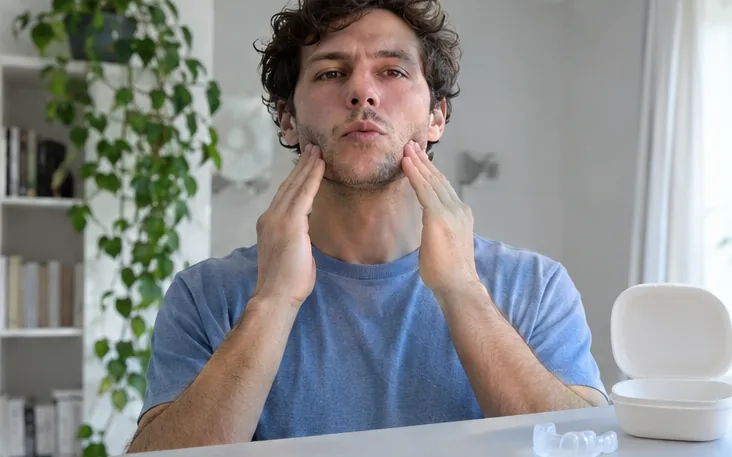
You wake up with a tight jaw, your dentist has spotted some wear on your teeth, and now you are weighing up two options: a night guard, or a set of jaw exercises you have seen recommended online.
You are far from the only person stuck on this choice, and the honest answer depends on what you want to fix. Below I compare what each option actually does, what the research says, and when it makes sense to use both.
Key takeaways
For jaw pain and limited mouth opening, a 2021 meta-analysis of six trials with 498 people found no clear difference between exercise therapy and splints (Zhang et al., 2021). They are not interchangeable, though. A night guard protects your teeth from grinding damage, while exercises work on the muscles and joint that hurt.
- A night guard shields your teeth, but there is not enough evidence that it stops grinding (Macedo et al., 2007).
- The 2023 BMJ guideline strongly recommends supervised jaw exercise and stretching for chronic TMD pain, and conditionally recommends against reversible splints (Busse et al., 2023).
- If you have both tooth wear and jaw pain, a guard at night plus exercises during the day covers both problems.
What does a night guard actually do?
A night guard is a plastic appliance that fits over your upper or lower teeth while you sleep. The US National Institute of Dental and Craniofacial Research describes these appliances as devices that protect the teeth and may help with habit reversal, such as jaw clenching. They do not change your teeth or your bite, and the NIDCR adds that there is not a lot of evidence on whether they improve TMD pain (NIDCR, 2026). The NHS puts it the same way for grinding: guards and splints are worn at night and protect your teeth from damage (NHS teeth grinding, 2026).
What a guard does not do is stop the grinding itself. A Cochrane review of splints for sleep bruxism concluded there was not enough evidence that a splint treats sleep bruxism, while noting it may offer some benefit for tooth wear (Macedo et al., 2007). Think of it as a bumper between your teeth. The muscles behind it can keep working.
What do jaw exercises actually do?
Jaw exercises target the parts that hurt and stiffen: the chewing muscles, the joint and the way you move your jaw. They usually combine gentle stretching, controlled opening and closing, posture work and relaxation. The NIDCR lists exercises to gently stretch and strengthen the jaw muscles among the first steps for jaw discomfort, together with soft food, heat or cold and cutting down on habits like clenching (NIDCR, 2026). The NHS also suggests seeing a physiotherapist for jaw exercises and massage when self-care is not enough (NHS TMD, 2026).
A meta-analysis from a US physical therapy department found that exercise therapy gave moderate short-term benefits for pain and clear gains in range of motion, though no significant improvement in function (Dickerson et al., 2017). An earlier review was more cautious and found no high-quality evidence either way, so the size of the effect is still uncertain (Armijo-Olivo et al., 2016).
Jaw exercises vs night guard: a side-by-side comparison
| Night guard | Jaw exercises | |
|---|---|---|
| Main job | Protects teeth from wear at night | Eases muscle and joint pain, improves movement |
| Stops grinding? | Not shown (Macedo et al., 2007) | No, but cutting down habits like daytime clenching is a recommended first step (NIDCR, 2026) |
| Evidence for TMD pain | Very low certainty, no clear pain reduction (Riley et al., 2020) | Moderate short-term benefit for pain and opening (Dickerson et al., 2017) |
| BMJ 2023 guideline for chronic pain | Conditional recommendation against | Strong recommendation for |
| When you use it | While you sleep | A few minutes during the day |
| Who provides it | Dentist | Physiotherapist, then at home |
What does the research say when you compare them directly?
The clearest head-to-head data come from a 2021 meta-analysis of six trials in people with painful TMD. Exercise therapy was not superior to splints for pain, and the two were equivalent for mouth opening and side-to-side movement. The authors concluded there was no high-quality evidence to tell the two apart (Zhang et al., 2021).
The large guideline published in the BMJ in 2023 compared conservative, drug and invasive treatments for chronic TMD pain lasting three months or more. An international panel that included patients gave strong recommendations for supervised jaw exercise and stretching, therapist-assisted mobilisation, manual trigger point therapy, cognitive behavioural therapy and usual care such as home exercises, reassurance and education. Reversible occlusal splints received a conditional recommendation against them (Busse et al., 2023). The guideline covers chronic pain, so it says nothing about protecting teeth from grinding.
A systematic review led by Cochrane Oral Health pooled 37 trials and found, with very low certainty, no evidence that splints reduced pain across TMD as a group. No trial in that review measured tooth wear in people with bruxism (Riley et al., 2020). So the case for a guard rests mainly on protecting teeth, and the case for exercise rests on pain and movement.
For a broader look at alternatives to splints, see my night guard alternative guide. If your guard seems to be making things worse, read can a night guard make TMJ worse.
When does it make sense to use both?
Using both makes sense when your dentist sees wear, chips or cracks from night-time grinding and you also have jaw pain or stiffness. The guard takes care of your teeth at night, and exercises work on the muscles during the day. Cleveland Clinic notes that most people who grind can ease symptoms with a custom mouth guard, and it also lists stress reduction and lifestyle changes as part of treatment (Cleveland Clinic, 2026).
If your main problem is pain and tightness without visible tooth damage, and it has lasted three months or more, the BMJ guideline puts exercises and self-management ahead of a splint. If you are not sure whether you grind at all, start with how to tell if you grind your teeth at night.
For the moment
Let your teeth part, rest your tongue on the roof of your mouth and breathe slowly through your nose. The NIDCR lists heat or cold on the face for jaw discomfort (NIDCR, 2026), and the NHS lists an ice pack for jaw pain or swelling (NHS teeth grinding, 2026).
In the long run
Exercises need regular practice before they show results. My article on how long jaw exercises take to work explains what to expect, and the TMJ exercises hub has a full routine.
Try it: a two-minute jaw reset
This is the first routine I teach in physiotherapy when someone wants to know whether exercises are worth a try. Do it once in the morning and once in the evening.
- Sit upright and let your shoulders drop. Rest the tip of your tongue just behind your upper front teeth, with your lips closed and your teeth apart.
- Keeping your tongue there, slowly open your mouth as far as is comfortable and close it again. Repeat six times. Your jaw should move straight down without sliding to one side.
- Place two fingers on the thick muscle at the angle of your jaw. Open your mouth slightly and massage in small circles for 30 seconds on each side.
- Breathe in through your nose for four counts and out for six, three times, while you check that your teeth stay apart.
If any step causes sharp pain, a locking feeling or new clicking, stop and get it checked.
Is a night guard or an app better for teeth grinding?
The answer depends on what the grinding is doing to you, because the two tools solve different problems. A night guard is the better choice for protecting your teeth while you sleep, which is the job the NIDCR and the NHS describe for it (NIDCR, 2026; NHS teeth grinding, 2026). A guard has not been shown to stop the grinding itself (Macedo et al., 2007), and an app cannot do that during sleep either.
An exercise and reminder app is the better choice for daytime clenching, jaw pain and stiffness. Reminders help you catch the habit during the day, and cutting down habits like clenching is one of the first steps the NIDCR lists (NIDCR, 2026). Guided exercises support the home exercises and education that the BMJ guideline strongly recommends as usual care for chronic TMD pain (Busse et al., 2023).
Use both if your dentist finds tooth wear and you also have jaw pain or catch yourself clenching during the day. JawBuddy is a digital companion for guided jaw exercises and self-management, so it covers the daytime side while the guard protects your teeth at night. JawBuddy Therapy builds your personal plan with a therapeutic algorithm based on your symptoms and medical history. The app does not replace emergency care or an individual diagnosis from a qualified healthcare professional.
When should you see a doctor?
Get help right away (call 999, 911 or 112, or go to an emergency department) if:
- jaw pain comes with chest pain or tightness, or chest pain that spreads to your arms, neck or jaw (NHS heart attack, 2026)
- you have severe difficulty breathing
- your jaw is stuck open or shut after an injury or a fall
See a doctor or dentist soon if:
- you cannot eat or drink, or your jaw keeps locking (NHS TMD, 2026)
- you have frequent, severe headaches or pain at the side of your head or scalp
- your face is swollen or you have a fever with jaw pain
- your night guard leaves your bite feeling different in the morning
You have more than one option
You do not have to pick one camp. If your teeth need protecting, a guard does that job, and if your jaw hurts, exercises work on the pain and stiffness. A good next step is to read the teeth grinding guide and try the two-minute reset for a couple of weeks.
Frequently asked questions
Are jaw exercises as effective as a night guard?+
Does a night guard stop teeth grinding?+
What does the BMJ guideline recommend for chronic TMD pain?+
Should I use jaw exercises and a night guard together?+
Is a night guard or an app better for teeth grinding?+
References
- Macedo CR, Silva AB, Machado MA, Saconato H, Prado GF. Occlusal splints for treating sleep bruxism (tooth grinding). Cochrane Database of Systematic Reviews 2007, CD005514. ↗
- Armijo-Olivo S, Pitance L, Singh V, Neto F, Thie N, Michelotti A. Effectiveness of manual therapy and therapeutic exercise for temporomandibular disorders: systematic review and meta-analysis. Physical Therapy 96(1), 9-25, 2016. ↗
- Dickerson SM, Weaver JM, Boyson AN, et al. The effectiveness of exercise therapy for temporomandibular dysfunction: a systematic review and meta-analysis. Clinical Rehabilitation 31(8), 1039-1048, 2017. ↗
- Riley P, Glenny AM, Worthington HV, et al. Oral splints for temporomandibular disorder or bruxism: a systematic review. British Dental Journal 228(3), 191-197, 2020. ↗
- Zhang L, Xu L, Wu D, Yu C, Fan S, Cai B. Effectiveness of exercise therapy versus occlusal splint therapy for the treatment of painful temporomandibular disorders: a systematic review and meta-analysis. Annals of Palliative Medicine 10(6), 6122-6132, 2021. ↗
- Busse JW, Casassus R, Carrasco-Labra A, et al. Management of chronic pain associated with temporomandibular disorders: a clinical practice guideline. BMJ 383, e076227, 2023. ↗
- National Institute of Dental and Craniofacial Research (NIDCR). TMD (Temporomandibular Disorders). NIH. ↗
- NHS. Teeth grinding (bruxism). National Health Service, UK. ↗
- NHS. Temporomandibular disorder (TMD). National Health Service, UK. ↗
- Cleveland Clinic. Teeth Grinding (Bruxism). ↗
- NHS. Heart attack. National Health Service, UK. ↗
Continue reading
Masseter Botox vs jaw exercises: which works better for clenching?
Botox in the masseter can lower bite force and pain for a few months, while jaw exercises carry a strong guideline recommendation for chronic TMD pain. What the research says, side by side.
Should I see a dentist or a physiotherapist for jaw pain?
Not sure whether your jaw pain belongs with a dentist or a physio? A physiotherapist explains what each one does for TMD, who to see first and when you need a doctor instead.
JawBuddy vs BruxControl vs Unclench: which app is best for jaw clenching?
A physio compares JawBuddy, BruxControl and Unclench for jaw clenching using each developer's own listing: features, platforms, who built them and who each app suits.
Is there an alternative to CalmJaw?
Looking for a CalmJaw alternative? A physio compares CalmJaw with other TMJ apps, explains what the research says about relaxation and exercise, and helps you pick.