
Why does my masseter hurt?
Masseter pain usually comes from an overworked chewing muscle. Where it spreads, how to tell it apart from joint, tooth and gland problems, and what helps.

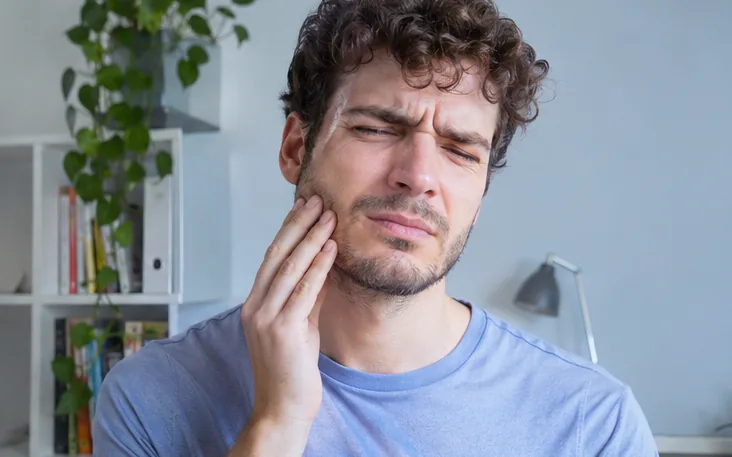
You press your fingers into your cheek just in front of the angle of your jaw and find a spot that is surprisingly sore. Maybe it aches after a stressful day, maybe it is worst when you wake up, or maybe it shows up halfway through a chewy meal. That spot is very often your masseter, and I examine it in almost every jaw patient I see as a physiotherapist.
You are far from the only one with a sore masseter, and in most cases it is an overworked muscle rather than something dangerous. This article explains what the masseter does, why it starts to hurt, where the pain can spread, how to tell it apart from other problems and what you can do about it.
Key takeaways
Masseter pain usually comes from an overloaded chewing muscle, often driven by clenching, grinding or stress. Pain in the chewing muscles is the most common symptom of temporomandibular disorders (NIDCR, 2026), and the 2023 BMJ guideline strongly recommends supervised jaw exercise, manual trigger point therapy and therapist-assisted mobilisation for chronic TMD pain (Busse et al., 2023).
- A sore masseter can send pain to your cheek, ear and teeth, so it often gets mistaken for something else.
- Massage, jaw exercises and learning to keep your teeth apart are the first things to try.
- Swelling, fever or jaw pain with chest pain need medical attention.
What is the masseter and why does it get sore?
The masseter is a thick, rectangular muscle that runs from your cheekbone down to the angle of your jaw. It lifts the lower jaw to close your mouth and is one of the strongest chewing muscles you have (Vasković, 2023). Clench your teeth with your fingers on your cheek and you will feel it bulge.
Like any muscle, it gets sore when it works too hard for too long. Clenching and grinding keep it switched on far beyond normal chewing, and the NHS lists a painful jaw among the symptoms of teeth grinding, which it says is often related to stress or anxiety (NHS, 2026). Chewing gum, biting nails and hard food add more load (NHS TMD, 2023). If you are unsure whether you clench, our guide on how to stop clenching your jaw during the day is a good place to start.
Where can masseter pain spread?
Masseter pain rarely stays put. In a study where firm pressure was applied to muscles in 230 people with TMD, 85 percent felt pain somewhere other than the spot being pressed, and the masseter was one of the most common sources. The cheek, ear and forehead were the most frequent places that pain landed (Wright, 2000).
The international diagnostic criteria for TMD use exactly this idea. Clinicians press on the jaw muscles and ask whether the pain is familiar and whether it spreads, which helps them tell local muscle pain apart from referred pain (Schiffman et al., 2014). So if your "earache" or "toothache" gets reproduced by pressing on your cheek, the masseter is a likely suspect. We go deeper into the tooth side in can TMJ cause tooth pain and into one-sided pain in why does my jaw hurt on one side.
Is it the muscle, the joint or something else?
The masseter sits right next to the jaw joint, a salivary gland and your back teeth, so it helps to know the differences. Muscle pain tends to feel like a dull ache that gets worse with chewing and better with rest or massage. Joint problems more often come with clicking, popping or locking near the ear. According to the NHS, TMD symptoms include pain around your jaw, ear and temple, clicking or popping noises, headache around your temples, difficulty opening your mouth fully and your jaw locking (NHS TMD, 2023). The NIDCR lists pain in the chewing muscles or jaw joint as the most common symptom, along with pain that spreads to the face or neck, jaw stiffness, limited movement or locking and painful clicking or popping (NIDCR, 2026).
The parotid salivary gland lies over the masseter. Salivary gland problems typically bring swelling that flares up, and intense pain at mealtimes can mean a stone is blocking the gland; redness and a high temperature point to infection (NHS salivary stones, 2023). A tooth problem usually hurts on one specific tooth, especially when you bite. If your jaw mostly feels stiff rather than painful, read why does my jaw feel tight.
What helps a sore masseter?
Several of the best-supported options are guided by a therapist, and some you can start yourself. The 2023 BMJ guideline for chronic jaw pain gives strong recommendations to supervised jaw exercise and stretching, manual trigger point therapy, therapist-assisted mobilisation and usual care such as home exercises, reassurance and education (Busse et al., 2023).
In the moment
- Let your teeth come apart. The NHS advises keeping your teeth apart except when you eat (NHS TMD, 2023).
- Massage the muscle. The NHS recommends massaging painful jaw muscles (NHS TMD, 2023), and a review of randomised trials found that massage and myofascial release on the chewing muscles worked better than control treatments (Calixtre et al., 2015).
- Try heat or ice. The NHS suggests a heat pack for 15 to 20 minutes twice a day or a wrapped ice pack for no more than 5 minutes at a time, whichever feels better (NHS TMD, 2023).
- Eat soft food for a few days and skip gum (NHS TMD, 2023).
Over the long run
Jaw exercises build on what massage starts. A meta-analysis found exercise therapy gave moderate short-term pain relief and improved how far the jaw moves (Dickerson et al., 2017). Our TMJ exercises page has a full routine. If you grind at night, a dentist can fit a guard to protect your teeth (NHS, 2026), though the BMJ guideline gives a conditional recommendation against reversible splints for chronic jaw pain itself (Busse et al., 2023). If someone has suggested injections, our comparison of masseter Botox vs jaw exercises lays out the evidence.
Try it: the masseter release
I show this to people with a sore masseter in their first session. Do it sitting, with your shoulders relaxed.
- Find the muscle. Place two or three fingertips on your cheek just in front of the angle of your jaw and clench lightly once. The part that bulges is your masseter.
- Let go completely. Part your teeth, keep your lips closed and rest your tongue on the roof of your mouth.
- Press gently into the muscle and make slow, small circles on each side, keeping the pressure light enough that it never turns painful.
- Slide your fingertips slowly down from the cheekbone towards the jaw angle three times, as if smoothing out a crease.
- Open your mouth slowly as far as is comfortable while keeping your tongue on the roof of your mouth, then close. Repeat a few times, keeping the movement straight and smooth.
You should feel the muscle soften and a mild, pleasant stretch. You should not feel sharp pain, numbness or a sense of the jaw catching. Stop if any of those happen. There is no studied dose for this self-massage, so go by comfort.
How JawBuddy helps
JawBuddy is a digital companion for guided jaw exercises and self-management. It takes you through jaw relaxation and exercise routines step by step, reminds you during the day to check whether you are clenching, and lets you log pain in a diary so you can see whether your masseter is calming down.
Every day the app picks one exercise for you, and a physiotherapist shows you each move on video. JawBuddy does not replace emergency care or an individual diagnosis from a qualified healthcare professional.
When to seek help
Call 999 or go to A&E right away if:
- jaw pain comes with chest pain or tightness, or chest pain spreads to your arm, neck or jaw (NHS heart attack, 2026)
- you feel short of breath, sweaty or sick together with jaw pain (NHS heart attack, 2026)
See a GP or dentist soon if:
- you cannot eat or drink, or your jaw locks or you cannot open your mouth fully (NHS TMD, 2023)
- you have frequent, severe headaches, tenderness at the side of your head or vision problems (NHS TMD, 2023)
- you have swelling that flares up, or pain and redness with a high temperature (NHS salivary stones, 2023)
- the pain keeps coming back despite self-care
A sore masseter usually settles with the right care
Most masseter pain comes from a muscle that has been working overtime, and it responds well to rest, massage and steady exercise. Try the masseter release once or twice today, notice when your teeth are touching, and read our jaw pain guide for the bigger picture.
Frequently asked questions
What causes masseter pain?+
Where can masseter pain spread?+
How do you relax a tight masseter muscle?+
Do mouth guards help with masseter pain?+
References
- Wright EF. Referred craniofacial pain patterns in patients with temporomandibular disorder. Journal of the American Dental Association 131(9), 1307-1315, 2000. ↗
- Schiffman E, Ohrbach R, Truelove E, et al. Diagnostic Criteria for Temporomandibular Disorders (DC/TMD) for Clinical and Research Applications. Journal of Oral & Facial Pain and Headache 28(1), 6-27, 2014. ↗
- Calixtre LB, Moreira RF, Franchini GH, Alburquerque-Sendín F, Oliveira AB. Manual therapy for the management of pain and limited range of motion in subjects with signs and symptoms of temporomandibular disorder: a systematic review of randomised controlled trials. Journal of Oral Rehabilitation 42(11), 847-861, 2015. ↗
- Dickerson SM, Weaver JM, Boyson AN, et al. The effectiveness of exercise therapy for temporomandibular dysfunction: a systematic review and meta-analysis. Clinical Rehabilitation 31(8), 1039-1048, 2017. ↗
- Vasković J. Masseter muscle. Kenhub, last reviewed 3 November 2023. ↗
- Busse JW, Casassus R, Carrasco-Labra A, et al. Management of chronic pain associated with temporomandibular disorders: a clinical practice guideline. BMJ 383, e076227, 2023. ↗
- NHS. Temporomandibular disorder (TMD). National Health Service, UK, page last reviewed 20 June 2023. ↗
- NHS. Salivary gland stones. National Health Service, UK. ↗
- National Institute of Dental and Craniofacial Research (NIDCR). TMD (Temporomandibular Disorders). NIH, accessed 25 November 2026. ↗
- NHS. Teeth grinding (bruxism). National Health Service, UK, page last reviewed 08 April 2026. ↗
- NHS. Heart attack. National Health Service, UK. ↗
Continue reading
Is there an app that measures how wide your jaw opens?
A physio explains how wide a mouth normally opens, how dentists measure it, what camera-based jaw tracking research shows and how to follow your jaw opening between appointments.
What is the 3 finger test for TMJ?
The 3 finger test checks whether your mouth opens wide enough to fit three stacked fingers between your front teeth. How to do it properly, what normal looks like in millimetres, where the test falls short and when to get your jaw checked.
Can teeth grinding cause tooth sensitivity?
Grinding and clenching can wear enamel down until cold drinks sting. Why grinding makes teeth sensitive, what else it could be, what helps and when to see a dentist.
Why does my tongue have teeth marks on the sides?
A scalloped tongue has wavy teeth marks along its edges. A physio explains what the studies say about clenching, sleep apnea and thyroid problems, and when to get it checked.