
Is there an app that measures how wide your jaw opens?
A physio explains how wide a mouth normally opens, how dentists measure it, what camera-based jaw tracking research shows and how to follow your jaw opening between appointments.

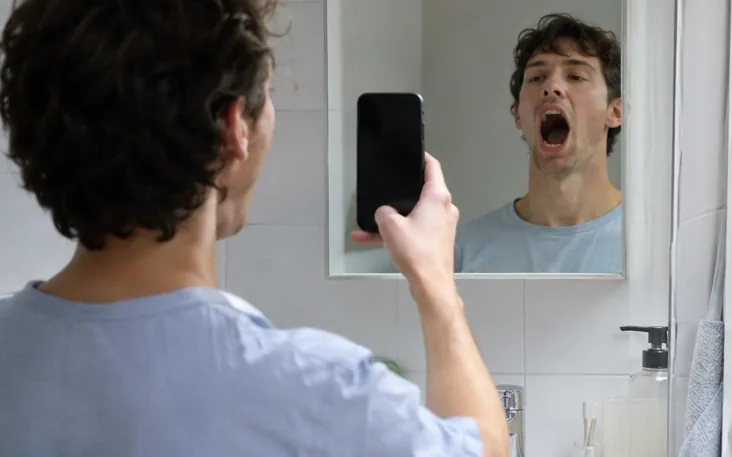
Maybe your jaw feels stiff when you yawn, or your dentist wrote "limited opening" on your chart and you want to know whether things are getting better. Plenty of people with jaw pain, clicking or teeth grinding look for a simple way to keep an eye on this at home, so you're in good company.
I'm Moritz, a physiotherapist who works with jaws every day. Below I explain what normal opening looks like, how clinicians measure it, what the research says about camera-based jaw tracking on phones, and how to use an app sensibly alongside your follow-up appointments.
Key takeaways
Yes, some apps use your phone's camera to follow your jaw movement, and the AR jaw check in JawBuddy 3.0 shows your opening in millimetres, and research shows camera-based tracking can describe mouth opening reliably in clinical settings (Jeon et al., 2022). A home app is best used to track your trend between visits. The clinical reference remains a ruler or caliper between the front teeth, with an assisted opening below 40 mm as the DC/TMD line for limited opening in a disc displaced without reduction (Schiffman et al., 2014).
- Three stacked fingers between your front teeth is a practical sign of normal opening.
- Measure the same way each time, because the trend matters more than one number.
- Sudden locking or difficulty opening fully needs a professional check.
How wide should your mouth open?
Most healthy adults open comfortably past three fingers. In a study of 140 dental students, the average maximum opening was 48.8 mm, and every participant could fit three fingers of either hand between the upper and lower front teeth (Zawawi et al., 2003). Only 12 of them managed four.
The normal range is wide. An American study of 330 healthy adults measured openings from 31 to 71 mm and found that age, height and weight all shifted the result (Venkatraman et al., 2020). That's why your own baseline tells you more than comparing yourself to someone else. If you want the full picture on causes, read limited mouth opening.
How do dentists and physios measure jaw opening?
The standard method is simple. You open as wide as you can and the clinician measures the gap between your upper and lower front teeth with a ruler or caliper. Under the international DC/TMD criteria, the examiner records how far you open without pain, how far you open on your own and how far with gentle assistance (Schiffman et al., 2014). An assisted opening below 40 mm, including the overlap of the front teeth, marks a disc displacement without reduction as one "with limited opening".
The incisor method isn't perfect either. A Belgian study found it highly reproducible but noted that it doesn't account for missing upper front teeth, and recommended corrected methods for those patients (Smeets et al., 2025). Some clinicians also measure the angle of opening with a mandibular goniometer, which a Dutch team showed can be measured reliably (Dijkstra et al., 1995).
Why does tracking jaw opening over time matter?
One measurement is a snapshot. Follow-up for teeth grinding, TMD or a recent closed lock is about direction, so you and your clinician want to see whether opening is improving, holding steady or getting worse. Because healthy openings vary so much between people (Venkatraman et al., 2020), a change against your own earlier values is often the more useful signal.
The NIDCR notes there is no single standard test that diagnoses TMD and that clinicians examine the jaw for tenderness, clicking or popping and difficulty with movement (NIDCR, 2026). Regular records of how your jaw moves give that examination more to work with, especially when appointments are weeks apart.
What does research say about phone and camera jaw tracking?
Camera-based tracking is a real research field. A Korean pilot study filmed 91 people opening and closing with a digital camera and used computer vision to trace the movement automatically (Jeon et al., 2022). The system was reliable, people with a normal disc position mostly showed a straight opening path, and those with a disc displaced without reduction opened less on average (35.8 mm against 44.9 mm).
A Brazilian team used infrared cameras and face markers to capture jaw range of motion and classify TMD groups, and concluded it should support diagnosis rather than stand alone (Calil et al., 2020). A 2026 systematic review of six trials found that mobile apps and telerehabilitation may be associated with better pain, jaw function and mouth opening in TMD, but rated the certainty of that evidence as very low (Xu et al., 2026).
What are the limits of measuring your jaw with an app?
The camera studies were run in research settings with stickers or markers placed on the lips, face or jaw (Jeon et al., 2022; Calil et al., 2020). Your bathroom at night is a different setting, so treat an app's millimetre reading as a personal trend measured the same way each time, and leave the clinical measurement and any diagnosis to your dentist or physio.
A camera also can't see inside the joint. Clinicians may recommend imaging such as MRI, and pain in the jaw or face isn't always caused by TMD (NIDCR, 2026). Use an app to notice change and bring it to the appointment.
Try it: a home check I show in physiotherapy
This is the quick check I teach so patients can follow their own opening between visits. Do it at the same time of day each time.
- Sit upright with your head straight and your tongue resting behind your upper front teeth.
- Open slowly as far as you comfortably can, without pushing into pain.
- Stack your index, middle and ring fingers vertically and see whether they fit between your front teeth up to the first finger crease (Zawawi et al., 2003).
- Note whether your jaw moved in a straight line or drifted to one side, and whether you felt clicking or pain.
- Write down the result, or record it in your app, so you can compare next week.
You should feel a stretch at most. Stop if you feel sharp pain, if your jaw catches and won't open further, or if it gets stuck open, and get help quickly if it won't close.
How JawBuddy helps
JawBuddy is a digital companion for guided jaw exercises and self-management. Since version 3.0, its AR jaw check uses your phone's camera to measure your mouth opening in millimetres and to show symmetry and deviation, so you can see whether your jaw opens in a straight line or drifts to one side. The value is there to track your opening over time and to share with your dentist or physiotherapist, and it is not a diagnosis or a clinical measurement. You can keep a pain diary alongside it and export your progress as a report. It's available on iPhone and Android, and what's new in JawBuddy 3.0 walks through the rest of the redesign.
The app does not replace an individual diagnosis from a qualified healthcare professional. If you want a reminder to relax your jaw during the day, see an app that reminds you to unclench your jaw, and for a wider comparison, read the best TMJ apps.
When to seek help
According to the NHS, typical TMD symptoms are pain around your jaw, ear and temple, clicking or popping noises, headaches around the temples, difficulty opening your mouth fully and your jaw locking (NHS, 2023). Clicking without pain is common and needs no treatment (NIDCR, 2026).
Get help right away / call emergency services (999 in the UK, 911 in the US, 112 in the EU) if:
- you have chest pain that spreads to your arm, neck or jaw (NHS, 2026)
Get an urgent appointment soon (the NHS advises an urgent GP appointment or 111) if:
- you can't eat or drink
- you have difficulty opening your mouth fully or your jaw is locking
- you have frequent, severe headaches, tenderness at the side of your head or problems with your vision (NHS, 2023)
You don't have to guess whether it's getting better
A few minutes of checking, done the same way each week, gives you and your clinician something concrete to talk about. Start with the three-finger check today, and if your jaw is sore, have a look at jaw pain and the TMJ exercises for what you can do next.
Frequently asked questions
Is there an app that measures how wide your jaw opens?+
How wide should your mouth open?+
How do dentists measure mouth opening?+
Why track jaw opening over time?+
References
- Dijkstra PU, de Bont LG, Stegenga B, Boering G. Angle of mouth opening measurement: reliability of a technique for temporomandibular joint mobility assessment. Journal of Oral Rehabilitation 22(4), 263-268, 1995. ↗
- Zawawi KH, Al-Badawi EA, Lobo SL, Melis M, Mehta NR. An index for the measurement of normal maximum mouth opening. Journal of the Canadian Dental Association 69(11), 737-741, 2003. ↗
- Schiffman E, Ohrbach R, Truelove E, et al. Diagnostic Criteria for Temporomandibular Disorders (DC/TMD) for Clinical and Research Applications: recommendations of the International RDC/TMD Consortium Network and Orofacial Pain Special Interest Group. Journal of Oral & Facial Pain and Headache 28(1), 6-27, 2014. ↗
- Venkatraman A, Kaval F, Takiar V. Body Mass Index and Age Affect Maximum Mouth Opening in a Contemporary American Population. Journal of Oral and Maxillofacial Surgery 78(11), 1926-1932, 2020. ↗
- Calil BC, da Cunha DV, Vieira MF, et al. Identification of arthropathy and myopathy of the temporomandibular syndrome by biomechanical facial features. BioMedical Engineering OnLine 19(1), 22, 2020. ↗
- Jeon KJ, Kim YH, Ha EG, et al. Quantitative analysis of the mouth opening movement of temporomandibular joint disorder patients according to disc position using computer vision: a pilot study. Quantitative Imaging in Medicine and Surgery 12(3), 1909-1918, 2022. ↗
- NHS. Temporomandibular disorder (TMD). National Health Service, UK. Page last reviewed 20 June 2023. ↗
- Smeets M, Croonenborghs TM, Van Dessel J, et al. Evaluating the reproducibility and validity of maximal mouth opening measurement techniques. Journal of Stomatology, Oral and Maxillofacial Surgery 126(4), 102107, 2025. ↗
- Xu K, Li L, He Y, et al. Effects of Digital Health Interventions on Pain, Maximum Mouth Opening, and Jaw Function in Individuals With Temporomandibular Disorders: A Systematic Review. Journal of Oral Rehabilitation 53(11), 2173-2189, 2026. ↗
- National Institute of Dental and Craniofacial Research (NIDCR). TMD (Temporomandibular Disorders). National Institutes of Health, accessed 25 November 2026. ↗
- NHS. Heart attack. National Health Service, UK, accessed 25 November 2026. ↗
Continue reading
Why does my masseter hurt?
Masseter pain usually comes from an overworked chewing muscle. Where it spreads, how to tell it apart from joint, tooth and gland problems, and what helps.
What is the 3 finger test for TMJ?
The 3 finger test checks whether your mouth opens wide enough to fit three stacked fingers between your front teeth. How to do it properly, what normal looks like in millimetres, where the test falls short and when to get your jaw checked.
Can teeth grinding cause tooth sensitivity?
Grinding and clenching can wear enamel down until cold drinks sting. Why grinding makes teeth sensitive, what else it could be, what helps and when to see a dentist.
Why does my tongue have teeth marks on the sides?
A scalloped tongue has wavy teeth marks along its edges. A physio explains what the studies say about clenching, sleep apnea and thyroid problems, and when to get it checked.