
Why does my jaw hurt when I yawn?
Your jaw aches, cracks or catches every time you yawn? A physio explains why yawning sets it off, how to tell muscle from joint pain and how to yawn without the pain.

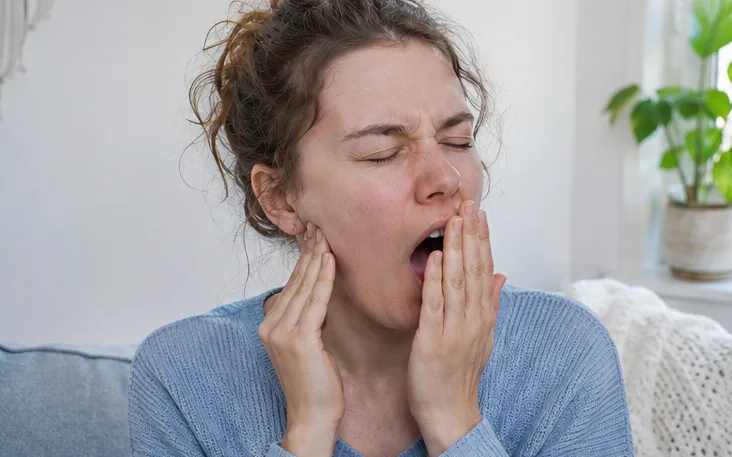
Every time you yawn, something in your jaw protests. It might be a dull pull in your cheek, a sharp spot right in front of your ear or a crack that makes you flinch halfway through. Since yawns sneak up on you, it can start to feel like you are bracing for pain several times a day. You are far from the only one: in a Polish study of 50 people with muscle-related jaw pain, yawning was one of the two most common everyday struggles, alongside chewing tough food (Kuć et al., 2021).
I am a physiotherapist who works with jaws every day, and in this article I explain why yawning in particular sets the pain off, how to tell whether your muscles or your joint are behind it and what a crack during a yawn means. You will also learn a simple way to yawn that takes the strain off, and which signs mean you should get checked.
Key takeaways
Yawning takes your jaw to its widest opening, so irritated chewing muscles or an irritated jaw joint often hurt most at that moment. In a study of 1,725 patients at an Italian clinic, painful yawning affected 49% of people with TMD and 14.2% of people without it (Reda et al., 2025).
- Painful yawning is strongly linked with TMD in the muscles or the joint, and a gentler way of yawning keeps your jaw away from the position that hurts most.
- A painless crack during a yawn is common and considered normal, while a painful click deserves a check with a dentist.
- If your mouth stays stuck open after a yawn, that is a dislocated jaw and needs the emergency department right away.
Why does yawning hurt more than chewing or talking?
When you chew or speak, your jaw moves through a small middle range. A full yawn is different. The ball of the jawbone glides forward out of its socket toward a ridge of bone, while the closing muscles in your cheeks and temples are stretched as far as they go. If either the joint or those muscles are already sore, this end-of-range position is exactly where you feel it.
The Italian study I mentioned makes the link quite clear. People with TMD were around six times more likely to have painful yawning, frequent yawners about five times more likely, and women about twice as likely, whether or not they had TMD (Reda et al., 2025). The authors suggest painful yawning could be an early sign of TMD, though they say this still needs to be confirmed. That fits the advice from the NHS, which lists "do not yawn too wide" among its self-help tips for TMD (NHS, 2023).
Muscle or joint: where is your pain coming from?
The international diagnostic criteria for TMD, called DC/TMD, separate the two most common pain types. In muscle pain (myalgia), pressing on the masseter in your cheek or the temporalis at your temple brings on your familiar pain. In joint pain (arthralgia), your familiar pain comes from pressing on the joint just in front of your ear or from moving the jaw (Schiffman et al., 2014). In both, the pain changes with jaw movement, chewing or clenching.
From what I see in practice, location gives you a first clue. A broad, dull ache across the cheek or temple usually points to the muscles. A small, sharp spot right in front of the ear points more to the joint. Many people have a mix of both, and only an examination can sort it out properly. If you want to understand the muscle side better, read why your jaw feels tight.
Why does it only hurt on one side?
In my practice, one-sided yawning pain is very common, because one joint or one set of chewing muscles is often more irritated than the other. The same muscle and joint clues from above apply to each side separately (Schiffman et al., 2014). I go through the possible causes in why does my jaw hurt on one side.
Is it normal for your jaw to crack when you yawn?
A small disc of cartilage sits between the ball of the jawbone and its socket. If the disc has shifted slightly forward and slips back into place as you open, you hear or feel a click. The DC/TMD call this disc displacement with reduction (Schiffman et al., 2014). The NIDCR says clicking or popping without pain is common, is considered normal and does not need treatment (NIDCR, 2026). A wide yawn is simply the moment the disc is most likely to jump.
It is a different story when the click hurts, when your opening gets more limited or when the jaw catches and you have to wiggle it to close. Painful clicking and locking are both on the NIDCR list of TMD symptoms (NIDCR, 2026). For a full rundown on clicks and pops, see jaw clicking.
What if your mouth won't close after a yawn?
If your mouth stays open after a yawn and your teeth no longer meet, the jaw is most likely dislocated. The MSD Manual describes a dislocated jaw as very painful and urgent, with a mouth that cannot close and a jaw that may be twisted to one side. Yawning and biting into a large sandwich are typical triggers (MSD Manual, 2026). Go to the emergency department right away, and do not try to push the jaw back yourself (healthdirect, 2024). A German review found that acute dislocations are put back by hand straight away, and that dislocations left for longer may no longer go back that way (Prechel et al., 2018).
This is an open lock, and it is a different problem from everyday yawning pain. Everything about it, including a jaw that catches open and then springs back, is covered in what to do if your jaw locks.
Try it: the gentle yawn
This is the technique I teach in physiotherapy when yawning hurts or the jaw catches. It does not replace an examination, but it keeps your joint out of that extreme end position.
- As soon as you feel a yawn building, breathe in slowly through your nose.
- Place the tip of your tongue on the roof of your mouth, just behind your upper front teeth, and keep it there through the yawn.
- Rest a fist or flat hand under your chin and give gentle upward pressure so your mouth cannot open all the way. The MSD Manual gives the same fist-under-the-chin tip to prevent jaw dislocation (MSD Manual, 2026).
- Let the yawn finish with your lips almost closed, breathing out through your nose.
- Afterwards, let your teeth rest slightly apart with your lips gently together.
Practise the movement a few times without a real yawn so it feels natural when the next one comes.
What helps when yawning hurts?
In the moment
The NHS suggests soft foods such as pasta, omelettes or soup, gently massaging sore jaw muscles and an ice pack or heat pack wrapped in a tea towel, whichever feels better. It also advises keeping your teeth apart except when eating and avoiding chewing gum or pen tops (NHS, 2023). Paracetamol or ibuprofen can help with flare-ups (NHS, 2023).
Long term
The NIDCR recommends heat or cold together with gentle exercises that stretch and strengthen the jaw muscles, and cutting back on habits like clenching, gum chewing and nail biting. It advises avoiding treatments that permanently change your teeth, bite or joint (NIDCR, 2026). Cleveland Clinic adds avoiding very large bites of food and finding ways to manage stress (Cleveland Clinic, 2025). You can find guided routines on our TMJ exercises page.
How JawBuddy helps
JawBuddy is a digital companion for guided jaw exercises and self-management, so you can build gentle exercises and a relaxed jaw resting position into your day. JawBuddy Therapy also includes micro programmes for acute complaints such as jaw clicking.
The app does not replace emergency care or an individual diagnosis from a qualified healthcare professional. A jaw that stays stuck open always needs a doctor first.
When should you see a doctor?
Right away: call 999 in the UK, 911 in the US or 112 in the EU, or go to the emergency department, if:
- your mouth stays open after a yawn and will not close (MSD Manual, 2026),
- your jaw pain started after a hard blow to the face, especially with hearing problems, facial numbness, fluid from your nose or ears or confusion (healthdirect, 2024),
- you have chest pain that spreads to your arms, neck or jaw (NHS heart attack, 2026).
Soon: book an urgent GP appointment or call 111 in the UK if:
- you are unable to eat or drink (NHS, 2023),
- your jaw is locking or you cannot open your mouth fully (NHS, 2023),
- you have vision problems such as double vision (NHS, 2023).
See a dentist if your jaw keeps catching at the end of a yawn, or if the cracking hurts (NIDCR, 2026). A dentist or a physiotherapist who treats jaws can check whether the joint is too loose or the disc is involved.
Your yawns can feel easy again
Pain when you yawn is annoying, but it often comes from irritated muscles or an irritated joint that you can calm down. Try the gentle yawn the next time you feel one coming and notice whether the pain eases. For a broader look at what causes pain in and around the jaw, head to our jaw pain guide.
Frequently asked questions
Why does my jaw hurt when I yawn?+
Is it normal for my jaw to crack when I yawn?+
Why does my jaw only hurt on one side when I yawn?+
How can I yawn without hurting my jaw?+
References
- Schiffman E, Ohrbach R, Truelove E, et al. Diagnostic Criteria for Temporomandibular Disorders (DC/TMD) for Clinical and Research Applications. Journal of Oral & Facial Pain and Headache 28(1), 6-27, 2014. ↗
- Prechel U, Ottl P, Ahlers OM, Neff A. The Treatment of Temporomandibular Joint Dislocation: A Systematic Review. Deutsches Ärzteblatt International 115(5), 59-64, 2018. ↗
- Kuć J, Szarejko KD, Gołębiewska M. Smiling, Yawning, Jaw Functional Limitations and Oral Behaviors With Respect to General Health Status in Patients With Temporomandibular Disorder-Myofascial Pain With Referral. Frontiers in Neurology 12, 646293, 2021. ↗
- NHS. Temporomandibular disorder (TMD). National Health Service, UK, page last reviewed 20 June 2023. ↗
- healthdirect Australia. Jaw dislocation. Last reviewed October 2024. ↗
- Reda B, Hmeidan M, Ajrouche R, Contardo L, Chahrour M. Painful yawning and temporomandibular disorder: a cross-sectional study among Italian patients. BMC Oral Health 25(1), 1799, 2025. ↗
- Cleveland Clinic. Temporomandibular Disorders (TMD). Last reviewed 22 July 2025. ↗
- National Institute of Dental and Craniofacial Research (NIDCR). TMD (Temporomandibular Disorders). National Institutes of Health, last reviewed September 2026. ↗
- Safar J. Jaw Dislocation. MSD Manual Consumer Version, reviewed August 2026. ↗
- NHS. Heart attack. National Health Service, UK, page last reviewed 31 March 2026. ↗
Continue reading
Why does my tongue have teeth marks on the sides?
A scalloped tongue has wavy teeth marks along its edges. A physio explains what the studies say about clenching, sleep apnea and thyroid problems, and when to get it checked.
Why are my teeth worn down?
Worn down teeth come from grinding, clenching, brushing or acid, usually several at once. A physio explains what your dentist checks and when worn teeth need treatment.
Why does my jaw hurt after dental work?
Jaw pain after a filling, crown, root canal or extraction is common. A physio explains what causes it, how long it normally lasts, what helps and which signs mean you should call your dentist.
Why can't I open my mouth all the way?
Limited mouth opening explained by a physio: how wide a mouth normally opens, the common and rare causes, how clinicians examine it, a three-finger check you can do at home and what helps.