
Does biofeedback work for teeth grinding and clenching?
EMG biofeedback can reduce jaw muscle activity in teeth grinding and clenching, but the effect on pain is unclear. A physio explains the research, the devices, how reminder apps differ and what works by day and by night.

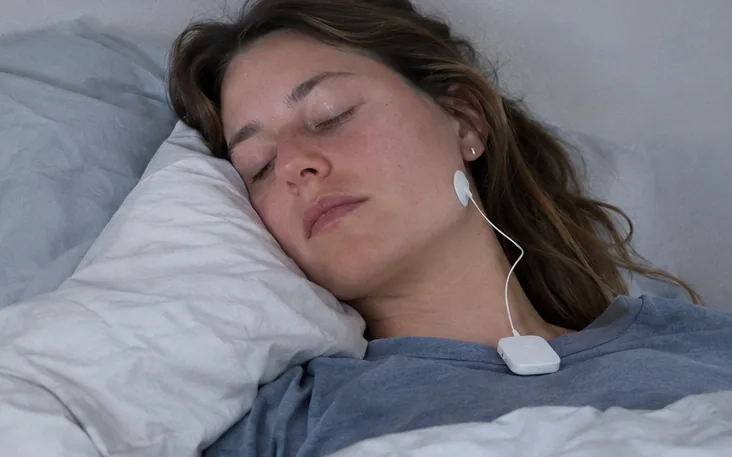
You might have read that a sensor can catch your jaw clenching and buzz you out of it, and now you are wondering whether that actually works, or whether the app on your phone already does the same thing.
Both are fair questions, and the honest answer depends on whether you clench during the day or grind at night. I am a physiotherapist who works with jaw problems every day, and in this article I explain what the research says about biofeedback, how real biofeedback devices differ from reminder apps, and what I would try first.
Key takeaways
Biofeedback can reduce jaw muscle activity in teeth grinding and clenching, but whether it reduces pain is still unclear. An umbrella review of 11 systematic reviews found that biofeedback consistently lowered masticatory muscle activity, while its effects on pain were inconsistent (Beriger et al., 2026). Most smartphone apps are reminder tools rather than biofeedback, because they have no sensor on your muscles.
- Night-time devices with an electrical or vibration signal reduced grinding activity in small trials, with little proof that pain improves.
- For daytime clenching, reminder prompts and other behavioural approaches show positive effects in a 2026 systematic review (Graham et al., 2026).
- The German guideline summary describes biofeedback as a support for behavioural therapy without a long-term effect (Lange & Peroz, 2019).
What is biofeedback for teeth grinding?
Biofeedback means a device measures something your body does and reports it back to you so you can notice and change it. The summary of the German bruxism guideline describes the signal as sound, vibration, electrical stimulation or a visual cue, triggered by the activity itself (Lange & Peroz, 2019).
For bruxism, the measured signal is usually electromyography (EMG), meaning the electrical activity of your chewing muscles picked up by a sensor on the skin over the masseter or temple. Some newer systems sit inside an oral appliance and measure bite force instead (Maejima et al., 2024). The key point is that the feedback arrives at the moment the muscle works, with no guessing involved.
Are there apps that use biofeedback to stop jaw clenching?
Very few phone apps are biofeedback in the strict sense. Most clenching apps send a prompt at random times during the day and ask what your jaw is doing, a method researchers call ecological momentary assessment (Zani et al., 2019). That is a reminder and self-monitoring tool, because the phone cannot measure your muscle.
Real biofeedback needs extra hardware: a wearable EMG patch or headband that pairs with an app, or a sensor built into a splint. If an app claims biofeedback, check whether it measures your muscle or simply reminds you on a timer. Both can be useful, but they answer different problems. I compare the reminder approach in detail in is there an app that reminds you to unclench your jaw?
Does biofeedback work for sleep bruxism?
The best-studied night-time method is contingent electrical stimulation (CES). An EMG sensor on the temple detects grinding or clenching and sends a mild, non-painful electrical pulse that makes the muscle let go. In a small randomised trial with 11 people who had muscle-related TMD and bruxism, jaw muscle episodes per hour of sleep fell by about 52% compared with baseline on the nights CES was switched on, without changing sleep length, but pain and muscle tension did not differ from the placebo group (Jadidi et al., 2013).
A Japanese study with 20 people found that stronger stimulation, still within each person's tolerance, went along with fewer grinding events and less muscle pain and stiffness (Kawahara et al., 2024). Another trial used vibration from an oral appliance over nine weeks: grinding episodes got shorter while the signal was on and became longer again within two weeks after it stopped (Maejima et al., 2024). A systematic review on sleep bruxism also found significant reductions in specific grinding measures with biofeedback, while calling for larger long-term trials (Minakuchi et al., 2022).
So these devices can quiet the muscle at night, but the trials measured the effect while people used them and the effect on pain is uncertain. If you are unsure whether you grind at night at all, start with an app to track teeth grinding at night.
What works for daytime clenching?
Daytime clenching, or awake bruxism, behaves more like a habit than a sleep reflex, so you can retrain it while you are conscious. A 2026 systematic review found no official guidelines for awake bruxism and only nine studies with 165 participants, but those studies generally suggested positive effects of biofeedback, reminder prompts, habit reversal, guided music listening and counselling with self-management (Graham et al., 2026).
Here reminder apps earn their place. In a 30-day trial with 72 people, awake bruxism behaviours dropped in everyone using a reminder app, and most in the group that added sticky-note reminders (Poluha et al., 2024). A daytime EMG device gives a more precise signal, yet a well-timed reminder already trains the same awareness. If you are not sure whether you also grind at night, read how do I know if I grind my teeth at night?
| Night (sleep bruxism) | Day (awake bruxism) | |
|---|---|---|
| What biofeedback looks like | EMG headband or splint sensor with electrical or vibration signal | Wearable EMG sensor with sound or vibration |
| What the research shows | Less muscle activity during use, pain effect unclear | Positive but limited evidence for biofeedback and reminders |
| Low-cost first step | Partner report, tracking, dentist check | Reminders plus a relaxed resting jaw position |
Try it: the resting position check
I teach this check in the first physio session because it is the skill every biofeedback device tries to build. Do it three or four times a day, ideally when a reminder goes off.
- Stop what you are doing and notice your teeth. If they touch, that counts as tension.
- Let your lips close gently and your teeth drift a few millimetres apart.
- Rest the tip of your tongue lightly on the roof of your mouth just behind your front teeth.
- Breathe slowly through your nose for three breaths and feel your cheeks and temples soften.
- Note in one word what you found: relaxed, touching, clenching or bracing.
You should feel your jaw muscles loosen and nothing should hurt. If opening or resting triggers sharp pain, clicking with locking, or the jaw gets stuck, stop and have it checked. The NHS puts it simply: apart from when you eat, your teeth should be apart (NHS TMD).
How JawBuddy helps
JawBuddy is a digital companion for guided jaw exercises and self-management, and it does not measure muscle activity, so it is not a biofeedback device. What it does is the daytime side: reminders during the day, a daily plan of short exercise videos, a pain diary and jaw movement tracking with your phone camera.
You can export a progress report to show your dentist or physiotherapist. Every day the app picks one exercise for you, and a physiotherapist shows you each move on video. JawBuddy is on iPhone and Android and does not replace an individual diagnosis.
When to seek help
According to the NHS, see a dentist if you grind your teeth and have tooth damage or sensitive teeth, pain in your jaw, face or ear, or a partner who hears you grinding at night (NHS teeth grinding). The NIDCR lists pain in the chewing muscles or jaw joint, limited movement or locking, painful clicking or popping and ringing in the ears as possible signs of TMD (NIDCR).
From my own practice, not from the sources above: get help right away or call emergency services if jaw pain comes with chest pain, shortness of breath or sweating, if your jaw locks open or shut after an injury, or if you have fever with swelling of the face or jaw.
Ask for an urgent GP appointment if you cannot eat or drink, your jaw locks or you cannot open your mouth fully, you have frequent severe headaches, pain at the side of your head or scalp, or vision problems such as double vision (NHS TMD). As a rule of thumb from my practice, jaw pain, headache or ear pain that lasts more than two weeks also deserves a check with your dentist or doctor.
You can train your jaw to let go
Biofeedback devices are a reasonable option if you want precise data, but the core skill is noticing tension and returning to a relaxed jaw, and that works with a reminder too. Start with the resting check above for one week, then read my overview of teeth grinding to plan the next step.
Frequently asked questions
Are there apps that use biofeedback to stop jaw clenching?+
Does biofeedback work for teeth grinding?+
Does biofeedback work for sleep bruxism?+
What works best for daytime clenching?+
References
- Jadidi F, Castrillon EE, Nielsen P, Baad-Hansen L, Svensson P. Effect of contingent electrical stimulation on jaw muscle activity during sleep: a pilot study with a randomized controlled trial design. Acta Odontologica Scandinavica 71(5), 1050-1062, 2013. ↗
- Lange M, Peroz I. Was wir heute über Bruxismus wissen (summary of the German S3 bruxism guideline). Zahnärztliche Mitteilungen (zm) 15/2019 (in German). ↗
- Zani A, Lobbezoo F, Bracci A, Ahlberg J, Manfredini D. Ecological Momentary Assessment and Intervention Principles for the Study of Awake Bruxism Behaviors, Part 1. Frontiers in Neurology 10, 169, 2019. ↗
- Minakuchi H, Fujisawa M, Abe Y, et al. Managements of sleep bruxism in adult: A systematic review. Japanese Dental Science Review 58, 124-136, 2022. ↗
- Kawahara S, Kusunoki T, Arikawa K, et al. Reduction of sleep bruxism events according to contingent electrical stimulus intensity. Journal of Oral Rehabilitation 51(9), 1785-1793, 2024. ↗
- Maejima K, Takaba M, Abe Y, et al. Effects of vibratory feedback stimuli through an oral appliance on sleep bruxism: A 14-week intervention trial. Journal of Dental Sciences 19(3), 1714-1721, 2024. ↗
- Poluha RL, Macário HS, Câmara-Souza MB, et al. Benefits of the combination of digital and analogic tools as a strategy to control possible awake bruxism: A randomised clinical trial. Journal of Oral Rehabilitation 51(6), 917-923, 2024. ↗
- Beriger C, Kohout K, Zumbrunn A, Ruales-Carrera E, Eyüboğlu TF, Özcan M. Biofeedback-Based Therapy in Patients With Myofascial Orofacial Pain and Bruxism: An Umbrella Review. Journal of Oral Rehabilitation 53(12), 2439-2455, 2026. ↗
- Graham DA, Lövgren A, Häggman-Henrikson B, Peck CC, Manfredini D, Saracutu OI. Management of awake bruxism: a systematic review. BMC Oral Health 26, 559, 2026. ↗
- NHS. Teeth grinding (bruxism). National Health Service, UK. Accessed 25 November 2026. ↗
- NHS. Temporomandibular disorder (TMD). National Health Service, UK. Accessed 25 November 2026. ↗
- National Institute of Dental and Craniofacial Research (NIDCR). TMD (Temporomandibular Disorders). National Institutes of Health. Accessed 25 November 2026. ↗
Continue reading
Is there an app that reminds you to unclench your jaw?
Yes, there are reminder apps for daytime jaw clenching. A physio explains the research behind them, how to track clenching every day with or without an app, and what to look for when you choose one.
Which app can track teeth grinding and clenching at night?
Phone apps can record grinding sounds at night, but they can't measure clenching or confirm bruxism. A physio explains what sound apps, EMG wearables and sleep labs can each tell you, and what to track during the day instead.
What is the difference between bruxism and TMJ disorder?
Bruxism is jaw muscle activity like clenching and grinding. TMJ disorder (TMD) is a group of pain and movement problems in the jaw joint and muscles. A physio explains how they differ, how they overlap and what helps each.