
Which app can track teeth grinding and clenching at night?
Phone apps can record grinding sounds at night, but they can't measure clenching or confirm bruxism. A physio explains what sound apps, EMG wearables and sleep labs can each tell you, and what to track during the day instead.

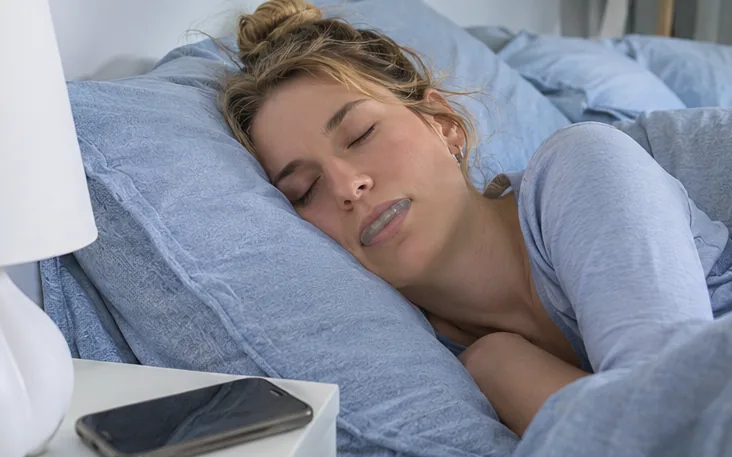
Maybe someone told you that you make a scraping noise in your sleep, or you wake up with a tired jaw and want proof before you book a dentist. Reaching for your phone to find out makes a lot of sense, and you're far from the only one doing it.
I'm a physiotherapist who works with jaw pain every day, and I get this question a lot. Below I go through what phone apps, wearables and sleep labs can each measure at night, what the studies say about their accuracy, and what you can usefully track during the day.
Key takeaways
Phone apps can record your night and flag sounds that might be grinding, so you can hear them in the morning. They cannot pick up silent clenching or confirm bruxism, and the gold standard remains a sleep study with muscle recordings plus audio and video (Li et al., 2024). Wearable EMG devices sit in between and work best as screening tools.
- A recording is a clue for your dentist rather than a diagnosis.
- EMG wearables measure jaw muscle activity but tend to overcount without audio and video (Li et al., 2024).
- Day-to-day pain, tension and jaw movement are easier to track well, and they show whether what you're doing is helping.
Which app can track teeth grinding at night?
Sound recording apps are the ones you'll find in the app stores. You put your phone next to the bed, it records through the night, and an algorithm marks the noises it thinks are grinding. Do I Snore or Grind is a long-running example: its App Store listing says it records snoring and teeth grinding sounds, filters them with an algorithm, lets you listen back the next morning and compare nights with and without a remedy, and stores your sleeping time in Apple Health (App Store, 2026). Several newer apps work the same way.
What these apps can give you is a recording you can play to your dentist, and that has real value. The NHS lists a partner noticing grinding in your sleep as a reason to see a dentist (NHS teeth grinding, 2026). What they can't give you is a diagnosis. A 2026 review of AI bruxism detection found that the audio studies were few, and two of them trained their models on grinding sounds from a public sound collection with no bruxism patients involved at all (Çekirge, 2026). I couldn't find a published study that tested a phone sound app against a sleep lab.
Can an app tell if I clench my jaw at night?
A microphone can only catch activity that makes a noise. The international bruxism definition includes clenching and bracing of the jaw, along with grinding (Lobbezoo et al., 2018), and clenching is mostly silent. So if you mainly clench, a sound app can show a quiet night even though your jaw muscles were working hard.
To measure silent clenching you need a sensor on the muscle itself. That is electromyography (EMG), which records the electrical activity of the masseter or temporalis muscle. The consensus group behind the bruxism definition names EMG as one of the instrumental methods for assessing bruxism (Lobbezoo et al., 2018).
How accurate are wearable EMG devices?
Portable EMG devices stick to the side of your face or sit in a small headband and record overnight at home. A 2014 systematic review compared them with polysomnography (PSG), the full sleep lab recording, and found mixed results. One EMG telemetry setup caught almost every bruxism episode but had 76.9% false positives, and only the Bruxoff device, which adds a heart signal to the muscle signal, came close to the lab (Manfredini et al., 2014). A later study of 49 people found Bruxoff had 83.3% sensitivity and 72% specificity, with a systematic difference in how many events it counted compared with the lab (Yanez-Regonesi et al., 2023).
Small single-channel devices have done well in some studies. In 20 people, a tiny wearable on the masseter matched the lab perfectly once the researchers set a cut-off suited to that device (Maeda et al., 2020). That is a small sample, though, and the cut-off came from the same group it was tested on.
The recurring problem is that without audio and video, these devices can't tell grinding from swallowing, coughing or moving in your sleep. A 2024 review of commercially available devices reports that portable recordings without audio-video tend to overestimate sleep bruxism, with a sensitivity of around 55% and a specificity of 80% (Li et al., 2024). The same review found that the accuracy of several devices, including GrindCare and Bruxoff, dropped as bruxism got more severe, and concluded that some are promising as screening tools (Li et al., 2024). Even a full sleep lab recording overestimated bruxism by 23.8% once its audio and video were removed (Carra et al., 2015).
What about smartwatches and sleep trackers?
A smartwatch doesn't measure your jaw. In a 2026 pilot study, people with probable sleep bruxism showed less deep and REM sleep and more waking on an Apple Watch than people without, but the authors say these estimates can't replace real sleep staging and need confirming with polysomnography (Akbulut and Akbulut, 2026). A watch can tell you something about how restless your nights are. It can't tell you whether your teeth were involved.
Do you even need to measure your nights?
For most people, no. Treatment for teeth grinding isn't always needed, and a dentist can recommend a mouth guard to protect your teeth from damage (NHS teeth grinding, 2026). Your dentist usually works from your history and what they see on your teeth and jaw. A 2026 review puts the sleep lab with audio and video at the top of the evidence but says it is best reserved for selected cases, partly because bruxism varies from night to night (Balasubramaniam et al., 2026).
Your own sense of whether you grind isn't very reliable either. In a sleep lab study of 170 women, self-reported grinding did not predict moderate or severe sleep bruxism on the recordings (Raphael et al., 2015). That's one more reason a recording or a dental exam beats guessing. If you want to read the signs yourself, our guide on how to tell if you grind your teeth at night walks through them.
Try it: a two-week night and day log
This is the log I suggest in practice when someone asks whether they should buy a gadget. It gives your dentist more to work with than a single recording.
- For two weeks, record your night with a sound app on three or four nights. Note the times it flags and listen to a few of them, because many will be snoring, rustling or talking.
- Each morning, rate jaw tightness and any pain from 0 to 10 within ten minutes of waking.
- Note whether you woke with a headache near your temples or sore teeth.
- Three times during the day, check whether your teeth are touching. At rest your lips can touch, your teeth stay apart and your tongue rests on the roof of your mouth.
- Note stress, alcohol, caffeine and late screen time next to each day, since the NHS links teeth grinding to stress, anxiety, alcohol and caffeine (NHS teeth grinding, 2026).
- Take the log and two or three of the clearest sound clips to your dentist.
You should feel nothing during this except a bit more awareness of your jaw. If the daytime checks keep finding your teeth together, that's worth its own attention, and our article on an app that reminds you to unclench your jaw covers that side in detail.
How JawBuddy helps
JawBuddy doesn't record your sleep or detect grinding at night. It's a digital companion for guided jaw exercises and self-management, so it covers the daytime side and your progress. You get a personal plan of short daily exercise videos, reminders, a pain diary and relaxation techniques. You can follow your jaw movement with your phone's camera and export your progress as a report for your dentist or physiotherapist.
That report fits well next to a night recording. The recording hints at what happens while you sleep, and the diary shows how your jaw feels and moves over weeks. If you're comparing options, our roundup of the best TMJ apps puts several apps side by side, and the night guard alternative page explains what a guard can and can't do.
When should you see a doctor?
Get help right away or call 999 if you have chest pain that spreads to your jaw, neck, arms or back, especially with shortness of breath or sweating (NHS heart attack, 2026).
Ask for an urgent GP appointment or call 111 if your jaw is locking, you can't open your mouth fully, or you can't eat or drink (NHS TMD, 2023).
See a dentist soon if you grind and have tooth damage, sensitive teeth or pain in your jaw, face or ear, or if a partner hears you grinding in your sleep (NHS teeth grinding, 2026). If you snore loudly or someone notices pauses in your breathing, mention it too, since sleep apnoea is linked to grinding. Our article on sleep apnea and teeth grinding explains why.
You can find out what your jaw is doing
Not knowing what happens at night is frustrating, but a cheap recording, an honest daytime log and one dental appointment usually answer more than any gadget alone. Start the two-week log tonight, and use our teeth grinding guide to plan what comes next.
Frequently asked questions
Is there an app that can track teeth grinding at night?+
Can an app detect jaw clenching while I sleep?+
How accurate are wearable EMG devices for sleep bruxism?+
What is the most accurate way to check for night grinding?+
References
- Manfredini D, Ahlberg J, Castroflorio T, Poggio CE, Guarda-Nardini L, Lobbezoo F. Diagnostic accuracy of portable instrumental devices to measure sleep bruxism: a systematic literature review of polysomnographic studies. Journal of Oral Rehabilitation 41(11), 836-842, 2014. ↗
- Carra MC, Huynh N, Lavigne GJ. Diagnostic accuracy of sleep bruxism scoring in absence of audio-video recording: a pilot study. Sleep and Breathing 19(1), 183-190, 2015. ↗
- Raphael KG, Janal MN, Sirois DA, Dubrovsky B, Klausner JJ, Krieger AC, Lavigne GJ. Validity of self-reported sleep bruxism among myofascial temporomandibular disorder patients and controls. Journal of Oral Rehabilitation 42(10), 751-758, 2015. ↗
- Lobbezoo F, Ahlberg J, Raphael KG, Wetselaar P, Glaros AG, Kato T et al. International consensus on the assessment of bruxism: Report of a work in progress. Journal of Oral Rehabilitation 45(11), 837-844, 2018. ↗
- Maeda M, Yamaguchi T, Mikami S, Yachida W, Saito T, Sakuma T et al. Validity of single-channel masseteric electromyography by using an ultraminiature wearable electromyographic device for diagnosis of sleep bruxism. Journal of Prosthodontic Research 64(1), 90-97, 2020. ↗
- Yanez-Regonesi F, Eisa E, Judge S, Carlson C, Okeson J, Moreno-Hay I. Diagnostic accuracy of a portable device (Bruxoff) to measure sleep bruxism. Journal of Oral Rehabilitation 50(4), 258-266, 2023. ↗
- NHS. Temporomandibular disorder (TMD). National Health Service, UK. Page last reviewed 20 June 2023. ↗
- Li C, Yap S, Loh A, Yap YJ, Kujan O, Balasubramaniam R. Ambulatory devices to detect sleep bruxism: a narrative review. Australian Dental Journal 69 Suppl 1, S53-S62, 2024. ↗
- Çekirge Ö. Artificial Intelligence for Sleep Bruxism Detection: A Technical Pipeline Synthesis. Diagnostics 16(17), 2865, 2026. ↗
- Akbulut K, Akbulut FG. Smartwatch-derived sleep estimates in individuals with probable sleep bruxism: an exploratory pilot study. BMC Oral Health 26(1), 1904, 2026. ↗
- Balasubramaniam R, Manfredini D, Guan G. Sleep Bruxism: A Narrative Review of Current Concepts, Mechanisms, and Clinical Implications. Journal of the Royal Society of New Zealand 56(2), e70046, 2026. ↗
- Apple App Store. Do I Snore or Grind, Consumer Sleep Solutions LLC, app listing. Accessed 20 November 2026. ↗
- NHS. Teeth grinding (bruxism). National Health Service, UK. Accessed 20 November 2026. ↗
- NHS. Heart attack. National Health Service, UK. Page last reviewed 31 March 2026. ↗
Continue reading
Is there an app that reminds you to unclench your jaw?
Yes, there are reminder apps for daytime jaw clenching. A physio explains the research behind them, how to track clenching every day with or without an app, and what to look for when you choose one.
What is the difference between bruxism and TMJ disorder?
Bruxism is jaw muscle activity like clenching and grinding. TMJ disorder (TMD) is a group of pain and movement problems in the jaw joint and muscles. A physio explains how they differ, how they overlap and what helps each.