
What is the difference between bruxism and TMJ disorder?
Bruxism is jaw muscle activity like clenching and grinding. TMJ disorder (TMD) is a group of pain and movement problems in the jaw joint and muscles. A physio explains how they differ, how they overlap and what helps each.

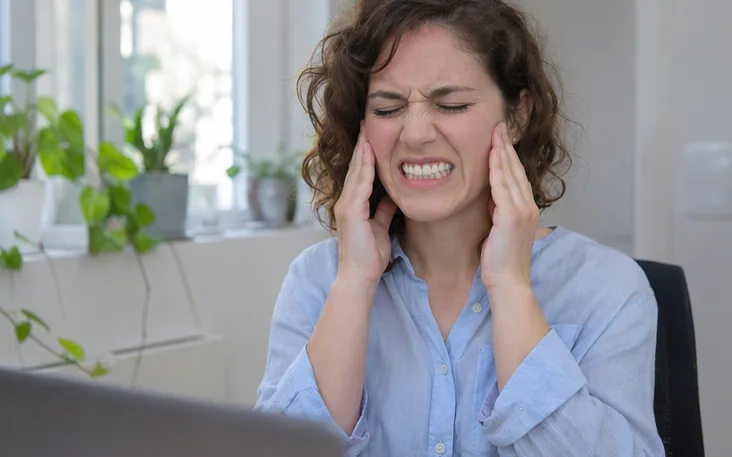
Maybe your dentist mentioned grinding marks on your teeth, and a week later someone else called your sore jaw "TMJ". It is easy to assume both words mean the same thing, and plenty of websites use them interchangeably. You are not doing anything wrong by mixing them up.
The difference matters, though, because it changes what you should work on. In this article I explain what each term means, how the two connect, and what actually helps for each, with a table you can come back to.
Key takeaways
Bruxism is a muscle activity: clenching, grinding, bracing or thrusting the jaw, during sleep or while awake. TMJ disorder (TMD) is a group of pain and movement problems in the jaw joint and chewing muscles. In healthy people bruxism counts as a behaviour that can be a risk factor, not a disorder in itself (Lobbezoo, 2018).
- You can grind without any jaw pain, and you can have TMD without grinding.
- Bruxism is associated with TMD pain, but strict studies show the link is weaker than self-report studies suggest.
- Both respond to conservative care, and daytime clenching is the part you can change most directly.
What is bruxism, exactly?
Bruxism is repetitive activity of the chewing muscles. An international group of experts defined it in 2013 and refined it in 2018: sleep bruxism happens during sleep and can be rhythmic or non-rhythmic, while awake bruxism shows up as repetitive or sustained tooth contact or bracing and thrusting of the lower jaw (Lobbezoo, 2018). If you want to work out which type you have, my article on how to know if you grind your teeth at night walks you through the signs.
The same consensus paper made a point that surprises many patients. In otherwise healthy people, bruxism should not be treated as a disorder but as a behaviour that can be a risk factor (or even a protective one) for certain clinical consequences (Lobbezoo, 2018). The NHS describes it in similar terms and lists stress and anxiety as the most common trigger, along with sleep problems, some medicines, smoking, alcohol and caffeine (NHS, teeth grinding).
What is TMJ disorder?
TMJ is the name of the joint itself, the temporomandibular joint in front of each ear. When people say "I have TMJ", they usually mean TMD, a temporomandibular disorder. The US National Institute of Dental and Craniofacial Research describes TMD as a group of more than 30 conditions that cause pain and dysfunction in the jaw joint and muscles (NIDCR).
Clinicians diagnose TMD with the DC/TMD criteria, which separate pain conditions such as muscle pain (myalgia) and joint pain (arthralgia) from joint problems such as disc displacement (Schiffman, 2014). Typical symptoms are pain around the jaw, ear or temple, clicking, headaches at the temples and difficulty opening wide (NHS, TMD). For the full picture, see the TMJ disorder guide.
Bruxism vs TMD at a glance
| Bruxism | TMD | |
|---|---|---|
| What it is | A muscle activity (clenching, grinding, bracing) | A group of pain and movement conditions |
| Disorder or behaviour? | A behaviour in otherwise healthy people | A clinical diagnosis |
| Main signs | Tooth wear, morning jaw tightness, a partner hearing grinding | Jaw, ear or temple pain, clicking, limited opening |
| Can it be painless? | Yes, often | Pain is usually the main complaint |
| How it is assessed | Self-report, dental exam, EMG, sleep study | Clinical exam with DC/TMD criteria |
| First steps | Notice and reduce clenching, protect teeth if needed | Self-care, jaw exercises, physiotherapy |
Does grinding your teeth cause TMD?
Grinding can contribute to TMD pain, but it is far from a simple cause. A systematic review of ten years of research found that studies based on self-report or clinical signs showed a positive association between bruxism and TMD pain, while studies using more precise measurement found a much lower association (Manfredini & Lobbezoo, 2010). The same review noted that experimental clenching can cause short-term muscle soreness that is different from ongoing TMD muscle pain.
A newer scoping review of 47 studies on sleep bruxism reached the same conclusion. Questionnaire studies tended to find a link with TMD pain, whereas studies using EMG or sleep recordings found a lower association or even a negative one (Manfredini & Lobbezoo, 2021). In practice this means bruxism is one risk factor among several. The NIDCR points to a mix of genes, psychological and life stressors and how a person perceives pain (NIDCR). If you want to know how common grinding is in the general population, see the bruxism statistics.
Can you have one without the other?
Yes, and it happens all the time. Many people who grind at night only find out because their dentist sees worn edges, and they never feel jaw pain. Others develop TMD after a knock to the face, through joint wear, or with stress as the main driver, without any obvious grinding (NHS, TMD).
When the two do appear together, in my practice daytime clenching is often the part people can most easily change. Holding your teeth together while you concentrate keeps the masseter and temporalis working when they should be resting, and NHS advice for TMD is to keep your teeth apart except when eating (NHS, TMD).
Try it: the teeth-apart check
This is the first check I show people in physiotherapy when they are unsure whether clenching is part of their jaw pain.
- Sit upright and let your lips close softly.
- Notice where your teeth are. At rest they should not touch.
- Rest the tip of your tongue lightly behind your upper front teeth and let your jaw hang a few millimetres open behind closed lips.
- Place two fingertips on your cheeks where the masseter bulges when you bite. Feel it go soft.
- Set a reminder to repeat this check several times a day for one week and note how often you catch your teeth touching.
If you keep catching yourself clenching, awake bruxism is likely part of your picture. If your jaw still hurts when your muscles are relaxed, a TMD assessment makes sense.
What helps with bruxism, and what helps with TMD?
Both start with conservative care. The NIDCR recommends avoiding irreversible treatments and starting with soft foods, heat or cold with gentle stretching and strengthening exercises, short-term over-the-counter pain relief and cutting down habits like clenching, gum chewing and nail biting (NIDCR).
For the moment
Use heat or a wrapped cold pack on the sore muscles, eat softer food for a few days and do the teeth-apart check whenever you notice tension (NHS, TMD). Avoid chewing gum and very wide yawns while things are flared up.
For the long term
For bruxism, the focus is the behaviour and what drives it: stress management, sleep, cutting back on caffeine, alcohol and smoking, and a custom night guard from your dentist if your teeth need protecting (NHS, teeth grinding). A guard protects the teeth, but the NIDCR notes that evidence it improves TMD pain is limited. For TMD, guided jaw exercises for TMJ, physiotherapy with manual therapy and approaches such as CBT or biofeedback can help (NIDCR). If grinding is your main concern, the teeth grinding hub collects everything we have on it.
How JawBuddy helps
JawBuddy is a digital companion for guided jaw exercises and self-management. It gives you a structured routine for relaxing the jaw muscles and catching daytime clenching, which is useful whether bruxism, TMD or both are part of your story.
The app does not replace emergency care or an individual diagnosis from a qualified healthcare professional. If your symptoms change or get worse, have them checked.
When should you see a doctor?
Get help right away or go to the emergency department if you have:
- jaw pain together with chest pain, shortness of breath or sweating
- a jaw that is suddenly locked open or shut and you cannot close or open your mouth
- swelling with fever, or jaw pain after an accident or a blow to the face
See a doctor or dentist soon if:
- you cannot eat or drink properly or your jaw keeps locking (NHS, TMD)
- you have frequent severe headaches, vision problems or tenderness on the side of your head
- you notice broken or very sensitive teeth, or jaw pain lasts longer than a few weeks
You don't have to figure this out alone
Bruxism and TMD overlap, but treating them as the same thing often means wearing a guard and hoping. Start by watching your daytime habits for a week with the teeth-apart check, and then read the TMJ disorder guide to decide on your next step.
Frequently asked questions
Is bruxism the same as TMJ disorder?+
Does bruxism cause TMD?+
Is bruxism a disorder?+
What helps with both bruxism and TMD?+
References
- Manfredini D, Lobbezoo F. Relationship between bruxism and temporomandibular disorders: a systematic review of literature from 1998 to 2008. Oral Surgery, Oral Medicine, Oral Pathology, Oral Radiology and Endodontics 109(6), e26-e50, 2010. ↗
- Schiffman E, Ohrbach R, Truelove E, et al. Diagnostic Criteria for Temporomandibular Disorders (DC/TMD) for Clinical and Research Applications. Journal of Oral & Facial Pain and Headache 28(1), 6-27, 2014. ↗
- Lobbezoo F, Ahlberg J, Raphael KG, et al. International consensus on the assessment of bruxism: Report of a work in progress. Journal of Oral Rehabilitation 45(11), 837-844, 2018. ↗
- Manfredini D, Lobbezoo F. Sleep bruxism and temporomandibular disorders: A scoping review of the literature. Journal of Dentistry 111, 103711, 2021. ↗
- NHS. Temporomandibular disorder (TMD). National Health Service, UK. ↗
- National Institute of Dental and Craniofacial Research. TMD (Temporomandibular Disorders). NIH. ↗
- NHS. Teeth grinding (bruxism). National Health Service, UK. ↗
Continue reading
Which app can track teeth grinding and clenching at night?
Phone apps can record grinding sounds at night, but they can't measure clenching or confirm bruxism. A physio explains what sound apps, EMG wearables and sleep labs can each tell you, and what to track during the day instead.
Is there an app that reminds you to unclench your jaw?
Yes, there are reminder apps for daytime jaw clenching. A physio explains the research behind them, how to track clenching every day with or without an app, and what to look for when you choose one.