
Can TMJ cause swallowing problems?
Swallowing feels like hard work and your jaw is sore? A physio explains how the jaw takes part in every swallow, what research on TMD and dysphagia shows, and when to see a doctor.

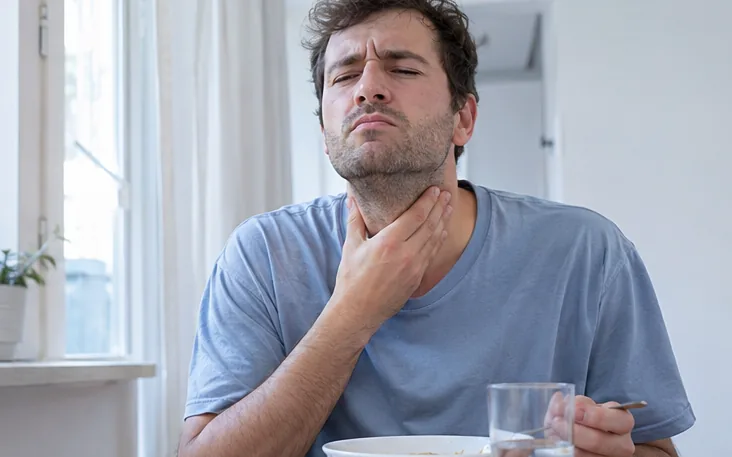
Maybe chewing a sandwich has started to feel like a workout, or the muscles under your jaw and chin get tired by the end of a meal.
You are not the only one. Below I explain how your jaw takes part in every swallow, what the research found and which signs mean you should see a doctor.
Key takeaways
TMD (temporomandibular disorders) can make eating and swallowing harder, mostly in the mouth stage where you chew and move food back. A review of 20 studies found swallowing itself impaired in 9.3% of people with TMD, while painful chewing affected 87.4% and chewing fatigue 62% (Gilheaney et al., 2018).
- The muscles under your chin connect your jaw to the hyoid bone and tongue, so jaw problems and swallowing share the same machinery (Matsuo & Palmer, 2008).
- Small studies show slower swallows and weaker tongues in people with chronic TMD, and one small trial found that targeted swallowing and tongue therapy helped.
- Food sticking in your throat or chest, choking, coughing when you drink or losing weight without trying all need a doctor to check for other causes first.
Can TMJ really cause swallowing problems?
It can contribute, though in most people the jaw causes more trouble with chewing than with the swallow itself. Speech and swallowing specialists call this oral stage dysphagia, meaning difficulty in the part of eating that happens in your mouth. In an Irish review of 20 studies of adults with diagnosed TMD, swallowing was impaired in 9.3%, but other signs of oral stage dysphagia were common, including painful chewing in 87.4% and chewing fatigue in 62% (Gilheaney et al., 2018).
The numbers were higher in two Irish studies from specialist clinics. When the same Irish team surveyed 178 TMD patients, 99% reported at least one sign of oral stage dysphagia. Painful chewing (90%) and chewing fatigue (78%) led the list, followed by difficulty swallowing (33%) and difficulty drinking liquids (28%) (Gilheaney et al., 2018). In a later study of 126 people at two national specialist centres, 53% had swallowing difficulties and 50% reported weight loss, and many said their eating problems affected daily and social life (Gilheaney et al., 2022).
These people attended specialist centres and mostly reported their own symptoms, so the figures may be higher than in the average person with TMD. They show that eating difficulty is a real part of TMD, though not that every swallowing problem in someone with a sore jaw comes from the jaw.
How does your jaw take part in swallowing?
Swallowing starts in your mouth. While you chew, the rhythm of your jaw is tightly coordinated with the movements of your tongue, cheeks, soft palate and hyoid bone, a small U-shaped bone at the top of your throat. When the food is ready, your tongue presses it back along the roof of your mouth into your throat (Matsuo & Palmer, 2008).
The muscles under your chin start on the lower jaw and attach to the hyoid bone and tongue. In the throat stage of the swallow, these suprahyoid muscles pull the hyoid bone and voice box upward and forward. That movement tucks the airway under the base of the tongue and is the most important force in opening the entrance to your food pipe (Matsuo & Palmer, 2008).
So jaw and swallowing muscles share attachments and work as one system, which is why I ask people with jaw pain how eating feels.
Why can swallowing feel like effort with TMD?
Several small laboratory studies point in the same direction. A Brazilian team recorded muscle activity in 23 people with chronic TMD (disc displacement with reduction and pain) and 27 people without jaw problems while they swallowed water and saliva. The TMD group took longer to swallow, their muscles under the chin peaked lower when swallowing water, and they recruited their jaw-closing muscles proportionally more than the control group (Fassicollo et al., 2019).
The tongue seems to be involved too. People with chronic TMD in another Brazilian study had a weaker tongue, both when pushing forward and when swallowing saliva, and the weaker the tongue, the worse their chewing and swallowing (Marim et al., 2019). In 30 young adults with untreated TMD, poorer tongue mobility, pressure and speed went together with poorer swallowing (Rosa et al., 2020).
A 2026 study again found lower tongue strength in 32 people with TMD than in 18 people without it, but on a standard swallowing questionnaire the two groups did not rate their swallowing differently (Germiniani et al., 2026). Measurable muscle changes do not always become a problem you notice.
How is this different from a sore throat or a lump feeling?
Pain in the jaw when you swallow, a sore throat with a tense jaw and the feeling of a lump in your throat are covered in can TMJ cause a sore throat, which also explains globus and Eagle syndrome. This page is about swallowing and chewing that take effort.
Where the trouble sits matters. Cleveland Clinic separates three types by where the problem sits: oral dysphagia in the mouth, where your jaw, teeth and tongue break food down; oropharyngeal dysphagia, where the tongue pushes food into your throat; and oesophageal dysphagia in the food pipe that carries it to your stomach (Cleveland Clinic, 2023). The TMD research above is mostly about the mouth stage. A feeling that food gets stuck lower down, behind your breastbone, points to the food pipe, which the TMD studies did not look at, so a doctor needs to check it.
Try it: the chew and swallow check
I use a version of this in physiotherapy when someone with jaw pain says eating has become hard work. It helps you describe your symptoms and does not replace a swallowing assessment. Skip steps 4 and 5 if you already cough, choke or feel food stick when you eat or drink, and see a doctor first.
- Sit upright and rest two fingertips lightly on the soft area under your chin and two on your voice box. Swallow your saliva and feel the area under your chin firm up and your voice box lift.
- Move your fingers to the thick chewing muscle at the angle of your jaw. Swallow again and notice whether you bite down hard while you swallow.
- Let your teeth part slightly, rest your tongue on the roof of your mouth and swallow once more. Notice whether this feels easier or harder.
- Take a small sip of water. Note whether it goes down smoothly or makes you cough.
- Chew a small piece of soft bread. Note whether your jaw tires, whether moving the food back is hard, or whether it feels stuck somewhere lower down.
Stop any step that hurts. If chewing and starting the swallow are the hard parts, mention your jaw at your appointment. If you cough on water or food feels stuck in your throat or chest, see a doctor first, as these are on the NHS list of signs that need an urgent appointment (NHS, 2026).
What helps when TMD makes eating hard?
For the moment
Soft foods take the load off both problems. The NIDCR lists eating soft foods among the first steps a doctor or dentist may suggest for jaw pain (NIDCR, 2026), and the NHS names softer foods as one of the changes that can help with swallowing problems (NHS, 2026). I also suggest smaller bites with short pauses so your jaw gets a break.
For the long term
The NIDCR recommends gentle exercises to stretch and strengthen the jaw muscles, cutting down on habits such as clenching and gum chewing, and relaxation techniques. It also says manual therapy can help improve function and relieve pain (NIDCR, 2026). If you clench during the day, our guide on how to stop clenching your jaw during the day goes step by step.
Swallowing can be trained directly too. In a small randomised study of 51 people with TMD-related oral dysphagia, those given orofacial myofunctional therapy, an exercise-based therapy for the muscles and functions of the mouth and face, improved most in jaw function, pain, swallowing difficulty and swallowing-related quality of life. They did better than people who had manual therapy plus exercises or home exercises alone (Çelik Güzel & Tuncer, 2025). The NHS lists swallowing therapy with a speech and language therapist among the treatments for dysphagia (NHS, 2026). For a starting routine, see our TMJ exercises.
How JawBuddy helps
JawBuddy is a digital companion for guided jaw exercises and self-management.
JawBuddy does not replace emergency care or an individual diagnosis from a qualified healthcare professional, and that matters especially for swallowing problems.
When should you see a doctor?
Difficulty swallowing should be checked by a doctor even if you know you have TMD (NHS, 2026).
Emergency: call emergency services (911 in the US, 999 in the UK, 112 in the EU) if you:
- have trouble breathing and think something is stuck in your throat (Cleveland Clinic, 2023),
- suddenly cannot swallow, or have sudden muscle weakness or paralysis (Cleveland Clinic, 2023).
Urgent: ask for an urgent GP or doctor's appointment (or call NHS 111 in the UK) if you:
- have difficulty swallowing that has not been checked by a doctor yet (NHS, 2026),
- cough or choke while eating or drinking (NHS, 2026),
- feel that something is stuck in your throat or food pipe after eating (NHS, 2026),
- keep bringing food back up, sometimes through your nose (NHS, 2026),
- have a wet, gurgly voice or feel short of breath after eating or drinking, or keep getting chest infections (NHS, 2026).
Book an appointment with your doctor if swallowing problems keep coming back, even if they feel mild, or if you are losing weight without trying. Cleveland Clinic notes that recurring dysphagia likely has a cause a doctor can diagnose and treat (Cleveland Clinic, 2023), and the NHS lists weight loss among the symptoms dysphagia can cause over time (NHS, 2026). UK guidance tells doctors to refer people with dysphagia on a suspected cancer pathway for oesophageal and stomach cancer (NICE, 2025).
Eating should not feel like a chore
Once your doctor has ruled out other causes, a tired jaw that makes eating harder is something you can work on. Do the check above today and take your notes to your next appointment.
For the full background, read our TMJ disorder guide or the jaw pain overview.
Frequently asked questions
Can TMJ cause swallowing problems?+
Why does swallowing feel like hard work when my jaw hurts?+
Can treatment help TMD-related swallowing difficulty?+
When is difficulty swallowing serious?+
References
- Matsuo K, Palmer JB. Anatomy and physiology of feeding and swallowing: normal and abnormal. Physical Medicine and Rehabilitation Clinics of North America 19(4), 691-707, 2008. ↗
- Gilheaney Ó, Béchet S, Kerr P, Kenny C, Smith S, Kouider R, et al. The prevalence of oral stage dysphagia in adults presenting with temporomandibular disorders: a systematic review and meta-analysis. Acta Odontologica Scandinavica 76(6), 448-458, 2018. ↗
- Gilheaney Ó, Stassen LF, Walshe M. Prevalence, Nature, and Management of Oral Stage Dysphagia in Adults With Temporomandibular Joint Disorders: Findings From an Irish Cohort. Journal of Oral and Maxillofacial Surgery 76(8), 1665-1676, 2018. ↗
- Fassicollo CE, Machado BCZ, Garcia DM, de Felício CM. Swallowing changes related to chronic temporomandibular disorders. Clinical Oral Investigations 23(8), 3287-3296, 2019. ↗
- Marim GC, Machado BCZ, Trawitzki LVV, de Felício CM. Tongue strength, masticatory and swallowing dysfunction in patients with chronic temporomandibular disorder. Physiology & Behavior 210, 112616, 2019. ↗
- Rosa RR, Bueno MDRS, Migliorucci RR, Brasolotto AG, Genaro KF, Berretin-Felix G. Tongue function and swallowing in individuals with temporomandibular disorders. Journal of Applied Oral Science 28, e20190355, 2020. ↗
- Gilheaney Ó, Stassen LF, Walshe M. The epidemiology, nature, and impact of eating and swallowing problems in adults presenting with temporomandibular disorders. Cranio 40(6), 476-484, 2022. ↗
- Cleveland Clinic. Dysphagia (Difficulty Swallowing): What It Is, Causes & Treatment. Health Library, last reviewed 20 August 2023. ↗
- Çelik Güzel H, Tuncer A. The efficacy of orofacial myofunctional therapy in oral dysphagia accompanying temporomandibular dysfunction. Cranio 43(4), 588-598, 2025. ↗
- National Institute for Health and Care Excellence (NICE). Suspected cancer: recognition and referral. NICE guideline NG12, 2015, amended 2025. ↗
- da Silva Germiniani J, Kuczera MS, Ferraz AX, Santos RS, Zeigelboim BS, de Araujo CM, et al. Evaluation of Swallowing and Tongue Strength Index in Patients With Temporomandibular Dysfunction: A Cross-Sectional Study. International Journal of Dentistry 2026, 2351314, 2026. ↗
- National Institute of Dental and Craniofacial Research (NIDCR). TMD (Temporomandibular Disorders). National Institutes of Health. Last reviewed September 2026. ↗
- NHS. Swallowing problems (dysphagia). National Health Service, UK. Page last reviewed 26 October 2026. ↗
Continue reading
TMJ Disorder: A Complete Guide to Causes, Symptoms, and Treatment
What TMJ disorder actually is, how to recognize it, and which treatments work according to current evidence. Medically reviewed by an Oral & Maxillofacial Surgeon.
How do I know if I have TMJ or just jaw tension?
Jaw tension and TMJ disorder overlap more than most people think. A physio explains the DC/TMD criteria, the signs that point to the joint itself, and a simple self-check you can do at home.
Is it bad to crack your jaw?
Why you feel the urge to crack your jaw, what actually pops inside the joint, whether forcing it can irritate things and what to do instead, from a physiotherapist.
Is jaw pain a sign of a heart attack?
Jaw pain can be a heart attack symptom, sometimes the only one. Which signs mean you should call 911 or 999 now, and how heart-related jaw pain differs from TMJ.